


A buyer in Germany has a container of goods ready in China and a forwarder offering more than one way home. Should it go by sea through Suez, around Africa, across the Arctic in summer, or overland by train? And where does the corridor through Iran and the Caspian fit in?
For China to Europe shipping in late 2026, the answer depends more than usual on the date. Most Asia-Europe container lines are back on the Suez route after almost two years around the Cape, the first scheduled Arctic container service has finished its season, and China-Europe rail volumes are growing again. This guide compares the options for one ordinary 40-foot box and says when each makes sense. Data as of November 2026.
What are the main routes from China to Europe?
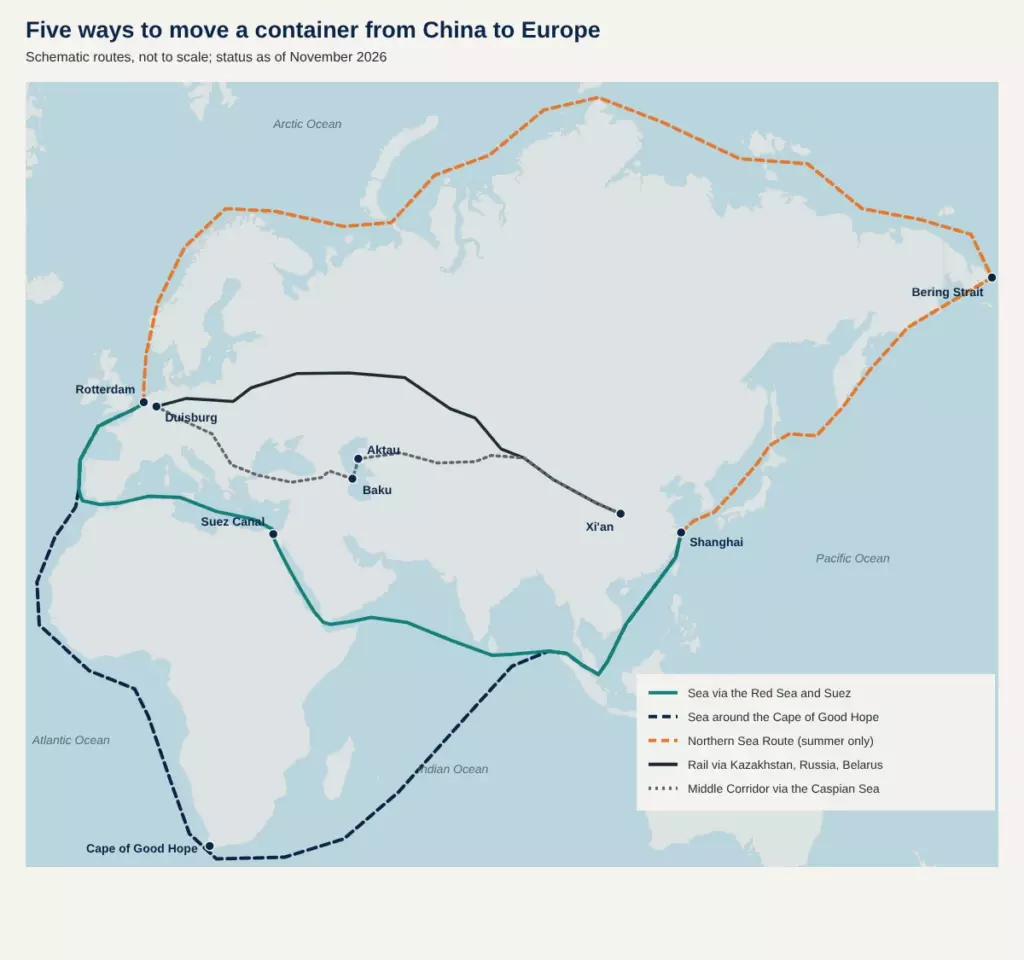
Map: Portolan, schematic routes; land outlines from Natural Earth
There are two sea routes used every week, one seasonal sea route and two overland families. By sea, ships sail either through the Red Sea and the Suez Canal or around the Cape of Good Hope; in summer a few ice-class ships take the Northern Sea Route along Russia’s Arctic coast. Overland, trains cross Kazakhstan, Russia and Belarus into Poland on the northern corridor, or Kazakhstan, the Caspian Sea, Azerbaijan, Georgia and Turkey on the Middle Corridor. The International North-South Transport Corridor (INSTC) through Iran belongs to a different map, as the section on it explains.
The sea routes carry most of the trade: a single large ship on the Suez route carries more than 24,000 TEU, while the whole northern rail corridor moved 310,579 TEU between China and the EU in 2025. The alternatives matter for what they offer when the main route is slow, expensive or closed.
How long does sea freight from China to Europe take now?
Through Suez, the voyage from Shanghai to Rotterdam is about 10,600 nautical miles, around 27 days of pure sailing at 16 knots; around the Cape it is about 13,800 nautical miles and around 35 days, according to the textbook Port Economics, Management and Policy. In the second half of August 2026, when many services still went around Africa, sea transits from China to Northern Europe averaged 42 days with a minimum of 31, according to GeekYum data published by the European Rail Alliance’s analysts.
The return to Suez is shortening that. By late October 2026, 63% of container capacity between the Far East and Europe was on Red Sea services, and services that switched back saved about seven days on average, Metro Global calculated on October 27. Why ships sailed around Africa from late 2023, and why they came back in steps after the conflict involving the United States, Israel and Iran began on February 28, 2026, is explained in our article on the Suez Canal and the Bab el-Mandeb.
Sea freight is also the price benchmark: the Drewry World Container Index put Shanghai to Rotterdam at $3,686 per 40-foot container on October 29, 2026, for the ocean leg only. What the other lines of the bill add is worked out in our article on what it costs to ship a container.
The Arctic shortcut works for a few weeks a year
The Northern Sea Route cuts the sea time roughly in half in summer. In 2026 the Chinese line Sealegend ran eight sailings between mid-August and late September from Ningbo-Zhoushan to Felixstowe, Rotterdam, Wilhelmshaven and Gdynia, with 18 to 20 days at sea according to Chinese state television. The ships were small, under 5,000 TEU, and the last two departures left early, on September 27, because ice was forecast to spread.
For a European importer the obstacles are commercial. MSC, Maersk, CMA CGM, Hapag-Lloyd and Evergreen have signed a pledge not to use Arctic routes, so the option comes through a forwarder or a smaller Chinese line. The cargo insurer must agree to cover the voyage, and every party in the deal has to pass the sanctions screening that applies to the importer, because the route is administered by Russia’s state company Rosatom. How permits, ice classes and escorts work is covered in our guide to the Northern Sea Route.
Is rail from China to Europe faster than sea?
On the clock, yes; on price, no. The fastest scheduled train from Xi’an reached Duisburg in 10 days and 20 hours over 9,908 km in November 2022, DB Cargo Eurasia reported; ordinary trains take longer, and in 2026 congestion on the German network added delays, the European Rail Alliance (ERAI) noted in June. The average China-Europe rail rate was about $10,000 per 40-foot container in August 2026, according to ERAI, against $3,686 by sea on the Drewry index at the end of October. The dates differ, so read the gap as an order of magnitude.
Volumes swing with the sea market. In 2025 rail traffic between China and the EU on the northern corridor fell 14.1% to 310,579 TEU as cheap sea freight around the Cape drew cargo away, and a closure of Poland’s border with Belarus in September 2025 halted trains for several days, Upply reported. In 2026 the trend reversed: China State Railway Group counted 5,460 China-Europe train trips in the first quarter, up 29% on the year, and ERAI put January to July container volume on China-Europe-China rail up 30%.
Did you know? China-Europe trains made 20,022 trips in 2025 and more than 130,000 in total since the service began, according to China’s National Development and Reform Commission, as reported by China Daily in July 2026.
The northern corridor crosses Russia and Belarus, so the goods, the rail operator and the payment chain must pass the sanctions screening that applies to the European buyer. Rail also carries no Red Sea risk.
Through the Caspian and Iran: the Middle Corridor and the INSTC
The Middle Corridor, officially the Trans-Caspian International Transport Route, avoids Russia. Trains run from China through Kazakhstan to the port of Aktau, ships cross the Caspian to Baku, and rail continues through Georgia and Turkey. Its growth in 2026 has outrun its capacity: volumes in July were up 168% on the year, but Chinese forwarders reported delays on the Caspian leg, with waiting times at Aktau of more than 20 days, ERAI wrote in August 2026.
The INSTC is often listed among China-Europe options, and that is a misreading of the map. The corridor runs north to south, from Russia through Iran to the Gulf and on to India; Russian Railways moved 11,000 containers on it in 2025, its chief executive told TASS. For a Chinese exporter its Iranian rail lines can be a link in a southern route through Iran to Turkey, which six countries, Iran, China, Turkey, Kazakhstan, Turkmenistan and Uzbekistan, agreed to develop at a meeting in Istanbul on November 25, 2025, Times of Oman reported. Since late February 2026, though, shipping to Iran’s southern ports has been severely restricted, and U.S. sanctions on Iran limit which banks and insurers will touch the cargo. How the corridor itself works is explained in our guide to the INSTC.
Five routes compared
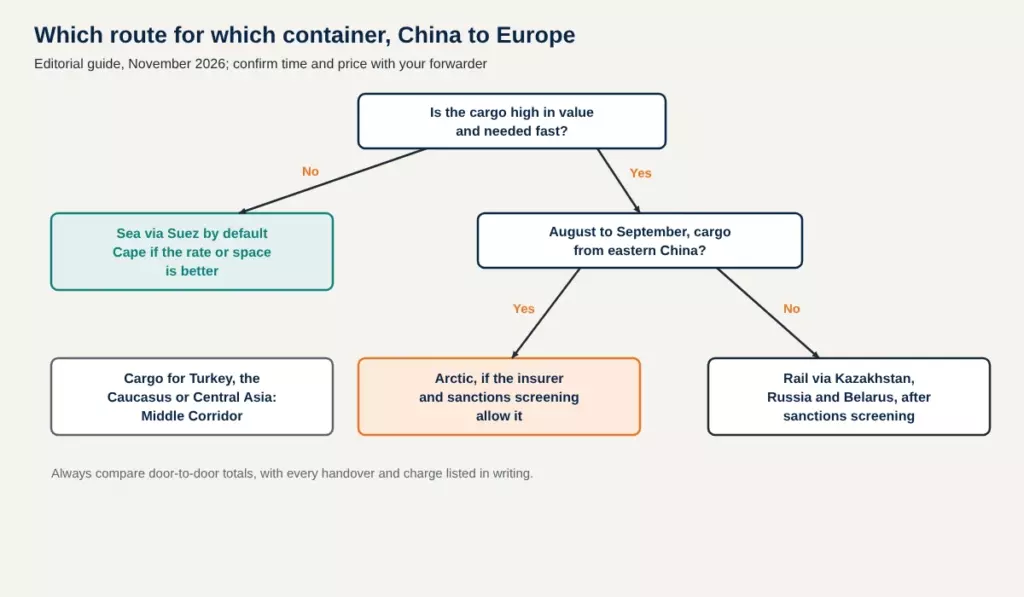
Portolan, editorial guide based on the route comparison, November 2026
Table 1. Shanghai or western China to Northern Europe: five options for a 40-foot container, as of November 2026
| Sea via Suez | Sea via the Cape | Northern Sea Route | Rail, northern corridor | Middle Corridor and Iran routes | |
|---|---|---|---|---|---|
| Time | about 27 days pure sailing, plus port calls | about 35 days pure sailing, plus port calls | 18 to 20 days at sea in 2026 | from about 11 days on the fastest scheduled train | not published as a scheduled door-to-door time; waits of more than 20 days at Aktau in summer 2026 |
| Price for one box | $3,686 Shanghai to Rotterdam, October 29, 2026 | in the same carrier rate | not published | about $10,000, August 2026 average | not published |
| Season | all year | all year | about August to September in 2026 | all year | all year, with Caspian weather |
| Main risk for the shipper | rerouting at short notice if Red Sea security changes | longer transit, more cargo in transit | early end of season, insurance, sanctions screening | border closures, network congestion, sanctions screening | transfers and waits at Caspian ports; sanctions on Iran |
Source: Port Economics, Management and Policy (sea distances and times); Drewry World Container Index via The Daily Cargo News (sea rate); CCTV via TASS and gCaptain (Arctic 2026 season); DB Cargo Eurasia, November 2022 (fastest train); European Rail Alliance, June and August 2026 (rail rate, Middle Corridor); Upply (border closure). Data periods differ by column, as shown in each cell.
Each alternative buys time with a specific risk, and only the two sea routes are sold by every major carrier at a published market rate. The others need a forwarder who has run them recently and will put the transit time in writing.
Which China to Europe route fits which cargo?
For most containers, a Suez service is the default again in late 2026: it is the cheapest per box, runs weekly and now saves about a week on the Cape. A Cape service still makes sense when a carrier offers a lower rate or more reliable space for cargo where a week matters little.
Rail fits high-value goods from inland China, where the factory sits closer to Xi’an or Chongqing than to a port and the weeks saved outweigh a rate more than twice as high. The Arctic suits summer shipments of valuable cargo from eastern China, if the insurer and the sanctions screening allow it. The Middle Corridor and the routes through Iran remain options for regional trade, to Turkey, the Caucasus and Central Asia, more than for a scheduled delivery to Rotterdam or Hamburg.
Whatever the route, ask the forwarder for the door-to-door time with each handover listed and for the price split into the same lines. The cheapest box on paper can become the most expensive one if it waits three weeks at a port.

