

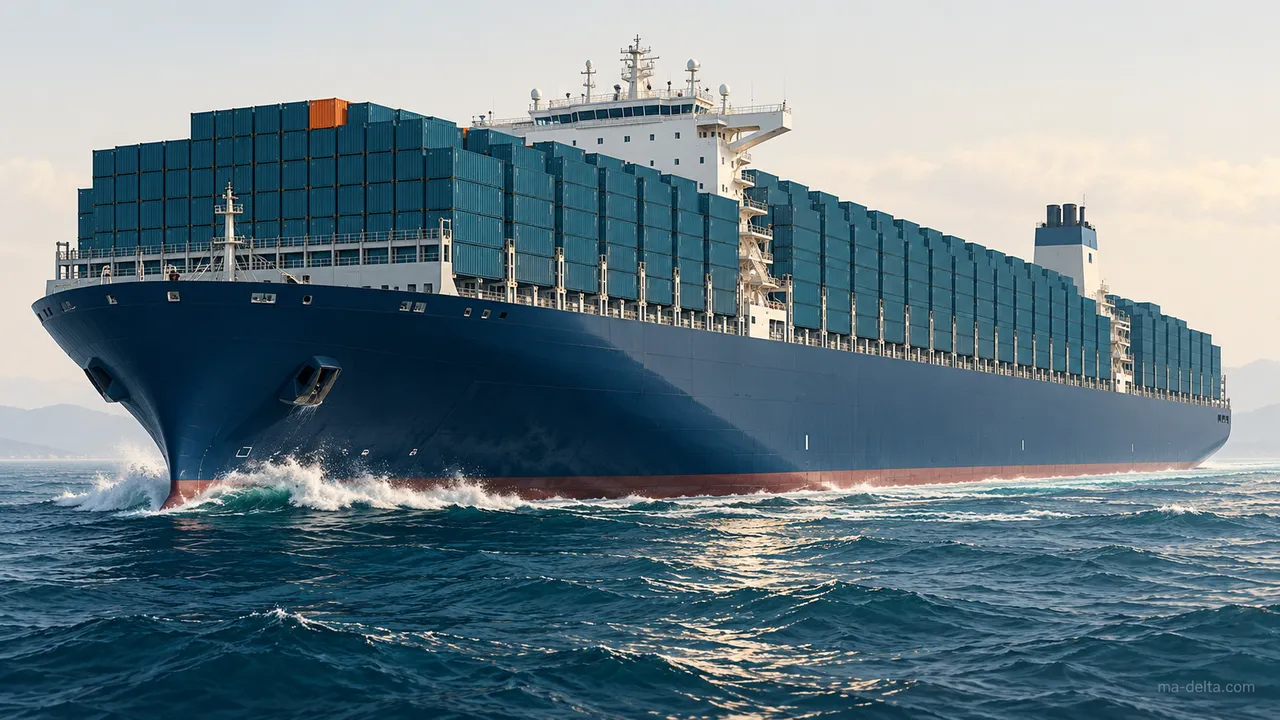
24,346 TEU. That is the capacity of MSC Irina, delivered by China’s Yangzijiang Shipbuilding to the Mediterranean Shipping Company on March 9, 2023, and still listed as the largest container ship in the world in October 2026. She is 399.99 meters (1,312 feet) long and about 61.3 meters (201 feet) wide, so four of her placed end to end would stretch almost exactly one mile, about 1.6 km.
Ship sizes are easier to grasp in the language the industry uses: Panamax, Neopanamax and ULCV. Each name marks a size limit, and most of those limits were set by canals and ports. This guide explains where each class comes from, what its dimensions are and why container ships have stopped growing, for now, at just under 400 meters.
What is the largest container ship in the world?
By capacity, the record belongs to MSC Irina and her sister ships, rated at 24,346 TEU, according to the shipbuilder’s handover reported by The Maritime Executive. TEU, the twenty-foot equivalent unit, counts how many standard 20ft containers a ship can carry; a 40ft box counts as two. Several other classes sit within a few hundred TEU of the record, and they share one striking feature: all of them are about 400 meters long and about 61 meters wide. Ocean Network Express’s ONE Innovation, rated at up to 24,136 TEU, belongs to the same group; ONE has not published its main dimensions in the delivery announcement, so it is not in the table.
| Ship (class) | Capacity, TEU | Length overall | Beam | Delivered | Operator |
|---|---|---|---|---|---|
| MSC Irina | 24,346 | 399.99 m (1,312 ft) | about 61.3 m (201 ft) | 2023 | MSC |
| OOCL Spain (also OOCL Piraeus) | 24,188 | 399.99 m (1,312 ft) | 61.3 m (201 ft) | 2023 | OOCL |
| MSC Tessa | 24,116 | about 400 m (1,312 ft) | about 61.5 m (nearly 202 ft) | 2023 | MSC |
| Ever Alot | 24,004 | 399.99 m (1,312 ft) | 61.5 m (202 ft) | 2022 | Evergreen |
| HMM Algeciras | 23,964 | 399.9 m (1,312 ft) | 61.0 m (200 ft) | 2020 | HMM |
Source: The Maritime Executive (MSC Irina, MSC Tessa), Maritime Gateway (OOCL), SWZ Maritime (Ever Alot), Marine Log (HMM Algeciras), delivery and naming reports; data as of October 2026
The capacities differ because each yard and owner counts slightly differently and fits the hull with different lashing and reefer arrangements. The outside dimensions barely differ at all. For context on how container ships fit among other cargo vessels, see our guide to types of cargo ships.
Where the class names come from
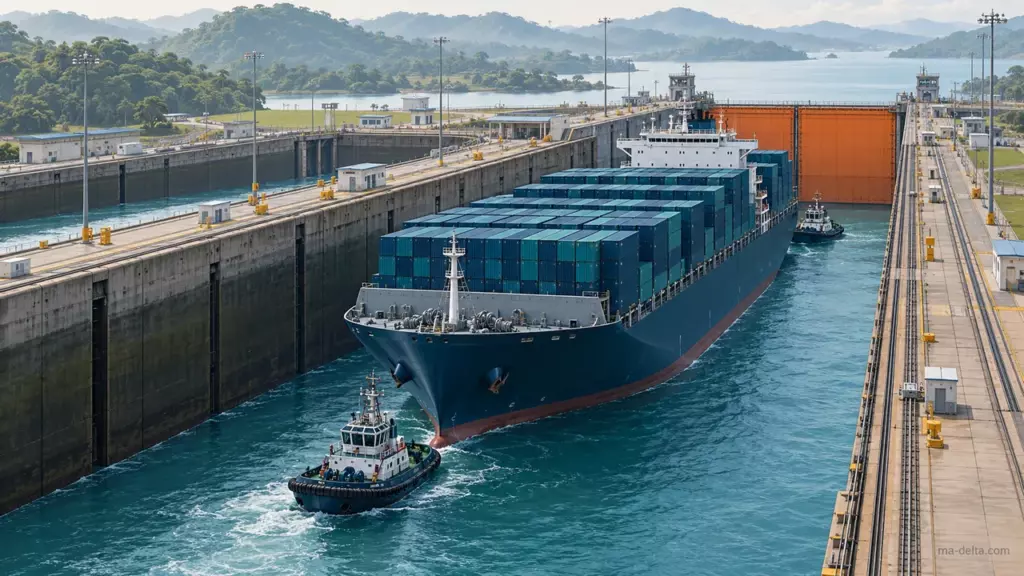
Illustration: Portolan. Illustration of a Neopanamax container ship inside a lock chamber of the Panama Canal with tugboats at bow and stern.
Most ship class names are a shorthand for a limit. Panamax means the largest ship that fits the original locks of the Panama Canal, opened in 1914. Neopanamax, also written New Panamax or Neo-Panamax, is the largest ship that fits the third set of locks opened in 2016. Suezmax, used mostly for tankers, describes the largest ship that can pass the Suez Canal loaded.
Above Neopanamax the names describe size alone. The Baltic Exchange, which publishes the industry’s freight benchmarks, bands container ships of 14,500 to 17,999 TEU as very large container ships (VLCS) and those of 18,000 to 23,000 TEU as ultra large container ships (ULCS); in everyday use ULCV, for ultra large container vessel, means the same. The bands are indicative, and the largest ships have already outgrown them.
How big are Panamax and Neopanamax ships?
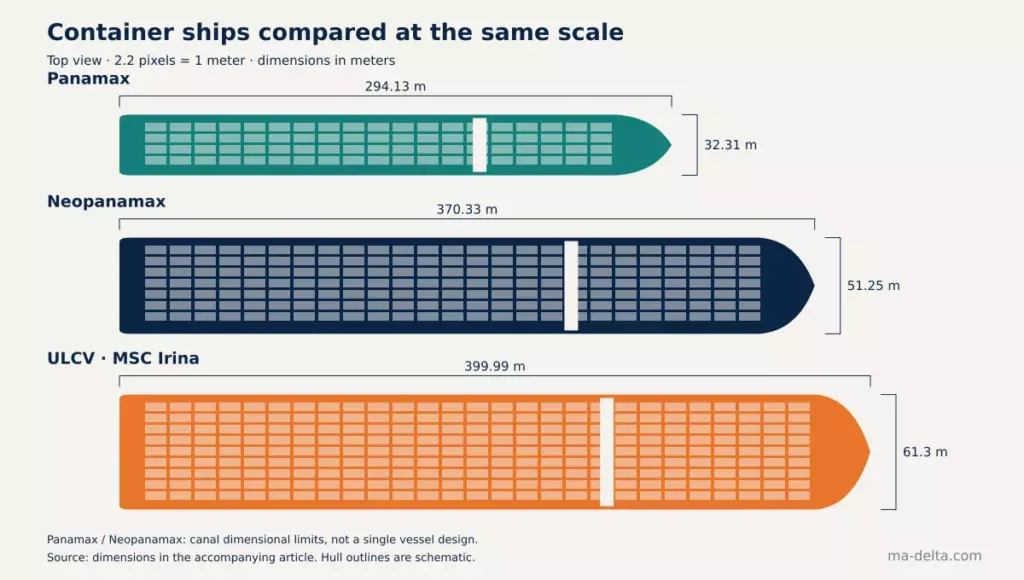
Diagram: Portolan, based on Panama Canal Authority limits and MSC Irina specifications, 2026
The Panama Canal Authority sets the maximum dimensions for each set of locks. For the original locks, a container ship may be up to 294.13 meters (965 feet) long and 32.31 meters (106 feet) wide, with a draft of 12.04 meters (39.5 feet) in tropical fresh water. In container terms, the Baltic Exchange bands Panamax ships at 3,000 to 5,199 TEU.
The Neopanamax locks raised every limit. The beam limit has been 51.25 meters (168 feet) since June 1, 2018, the maximum length rose to 370.33 meters (1,215 feet) in 2021, and the authority allows a draft of up to 15.24 meters (50 feet). These are the ships of 10,000 to 14,499 TEU in the Baltic Exchange’s bands, although real Neopanamax ships carry more: on August 30, 2024, the 17,640 TEU MSC Marie became the largest-capacity ship to pass the new locks, according to Container News.
| Limit | Panama Canal, original locks | Panama Canal, Neopanamax locks | Suez Canal |
|---|---|---|---|
| Maximum length | 294.13 m (965 ft) for container ships | 370.33 m (1,215 ft) | no length limit |
| Maximum beam | 32.31 m (106 ft) | 51.25 m (168 ft) | no fixed limit; widest ships pass in calm weather only |
| Maximum draft | 12.04 m (39.5 ft), tropical fresh water | 15.24 m (50 ft) | set by beam in the canal’s draught tables |
| Air draft | not covered here | 57.91 m (190 ft) | 68 m (223 ft) above high water |
Source: Panama Canal Authority (pancanal.com; Advisory A-11-2018; original locks as cited by the U.S. Bureau of Transportation Statistics); Suez Canal Authority Rules of Navigation, Article 52, and Circular 1/2000; data as of October 2026
The Suez Canal has no locks, so it limits the cross-section of the ship in the water instead of its length. The wider the ship, the less deep it may float, under the canal authority’s beam and draught tables, and there is no limit on length at all. A ship as wide as MSC Irina can therefore pass with a reduced draft. That is why the largest container ships can sail between Asia and Europe through Suez but are far too large for Panama.
Did you know? On August 30, 2024, the 17,640 TEU MSC Marie became the largest-capacity ship to pass the new Panama Canal locks, beating the 17,312 TEU Ever Max. Source: Container News.
Why have container ships stopped at 400 meters?
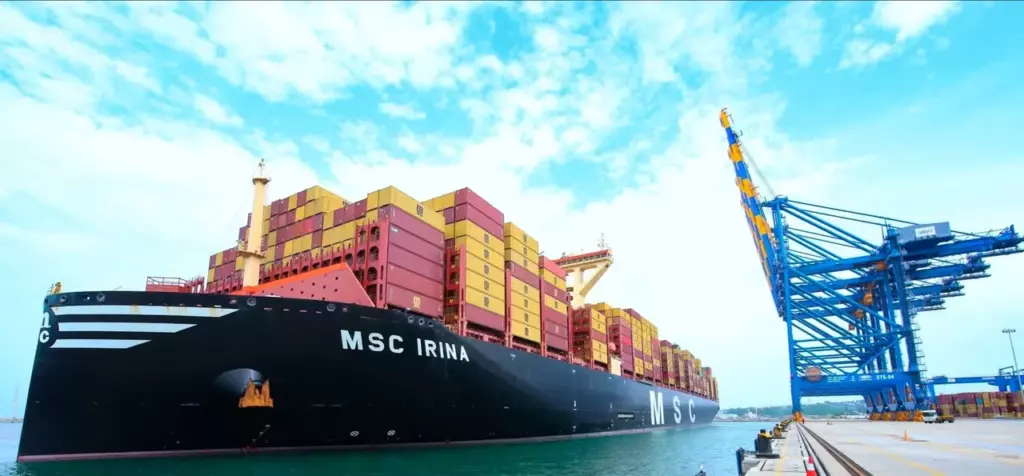
Arrival of MSC IRINA, the world’s largest container ship, at Vizhinjam International Seaport, Trivandrum in June 2025 marking its first arrival at a South Asian port. Photo: Giridharseeman. Wikimedia Commons, Creative Commons CC0 1.0 Universal Public Domain Dedication.
No ship in the record table is longer than 400 meters, and several stop just 1 cm short of it. That is no coincidence. Container terminals are built around quay length, crane outreach and turning basins. On our reading, 400 meters has become a common design limit for the largest berths and locks of the main hubs, and a longer ship would need longer berths, with fewer ships fitting along each quay.
Width is limited by the cranes. A ship about 61 meters wide carries containers in rows across its whole deck, and the ship-to-shore cranes at major terminals must reach the far row. Each step up in beam forces ports worldwide to buy bigger cranes. Draft is limited by channel depth, and dredging is expensive and slow to approve.
There is also the question of demand. A 24,000 TEU ship only pays off when it sails full on a long, dense route such as Asia to Northern Europe, and only a handful of ports on that route can handle it. Smaller ships that fit the Neopanamax locks can serve far more ports and routes, which in our view limits the appetite for ever larger hulls.
Does a bigger ship mean a cheaper box?
Economies of scale are the reason ships grew in the first place. A ship twice as large does not need twice the crew, and its fuel use per container typically falls because a larger hull carries more cargo for each unit of water resistance. Fuel is also where the next change is coming: many of the newest large ships can burn LNG or methanol, as our guide to marine fuels of the future explains.
The savings at sea are partly lost on land. Large ships arrive with thousands of boxes at once, creating peaks at terminals, in rail yards and on roads. When ships run late, the whole wave arrives at a different time, and smaller ports cannot absorb it. The size of a single hull also raises the stakes when something goes wrong, from a fire to a grounding in a narrow canal.
Size has a history of overshooting. The largest ship ever built was a tanker, and its story shows how quickly a giant can lose its advantage when trade patterns change. We tell it in our profile of Seawise Giant.
Will container ships get bigger?
For now the record has held for more than three years. The physical limits, quay lengths, crane reach and canal cross-sections, have not moved, and the Red Sea crisis showed that a route through the Suez Canal and the Bab el-Mandeb strait can close for long periods. Our explainer on why ships sail around Africa covers that risk, and our ranking of the largest container ports shows how few ports can host these ships.
The question for the next decade is open: will a carrier order the first container ship longer than 400 meters and persuade ports to follow, or has the container ship reached the size at which the world’s infrastructure, more than engineering, sets the limit?


