


A standard 20ft shipping container measures 6,058 mm long, 2,438 mm wide and 2,591 mm high on the outside, or 19 ft 10.5 in by 8 ft by 8 ft 6 in. A 40ft container is 12,192 mm (40 ft) long with the same width and height, and a 40ft high cube is one foot taller, at 2,896 mm (9 ft 6 in). These external dimensions are fixed by the international standard ISO 668, so every crane, truck chassis and ship’s cell guide in the world can handle them.
Inside, the numbers depend on the wall thickness of each box. For a typical steel dry container, a 20ft offers about 33 cubic meters of space, a 40ft about 68 and a 40ft high cube about 76. The tables below give the exact figures from a carrier’s specification, explain what limits the weight you can load and show how to read the size code painted on every door.
What are the dimensions of 20ft and 40ft containers?
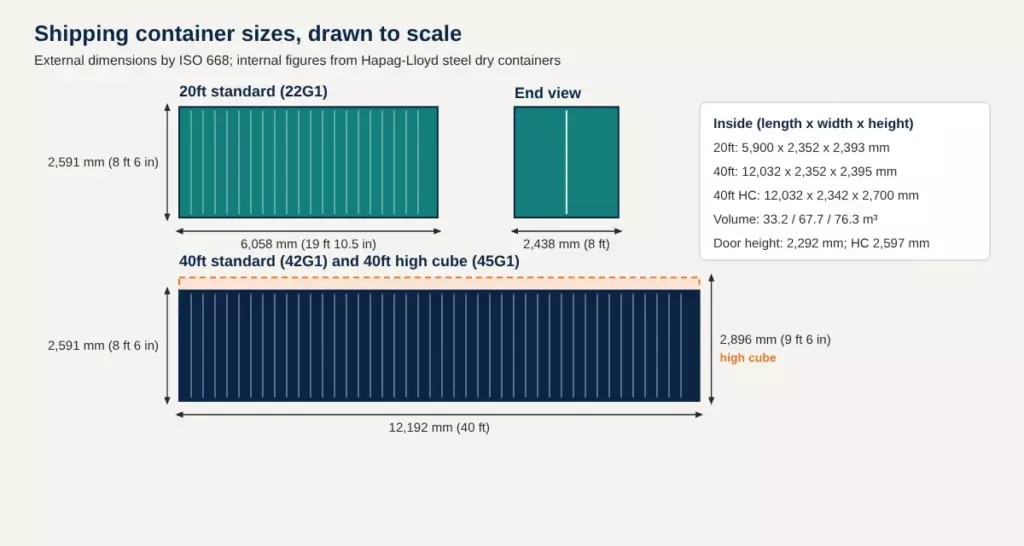
Diagram: Portolan, based on ISO 668 and Hapag-Lloyd container specification (2017), 2026
External dimensions are the ones set by the standard, and they are the same for every manufacturer. The “20-foot” name is a slight simplification: the box is an inch and a half short of 20 feet, so that two 20ft containers fit into the length of one 40ft with a small gap between them.
| Container | External length | External width | External height | ISO size-type code |
|---|---|---|---|---|
| 20ft standard | 6,058 mm (19 ft 10.5 in) | 2,438 mm (8 ft) | 2,591 mm (8 ft 6 in) | 22G1 |
| 40ft standard | 12,192 mm (40 ft) | 2,438 mm (8 ft) | 2,591 mm (8 ft 6 in) | 42G1 |
| 40ft high cube | 12,192 mm (40 ft) | 2,438 mm (8 ft) | 2,896 mm (9 ft 6 in) | 45G1 |
Source: ISO 668 dimensions as reproduced in the Hapag-Lloyd Container Specification (03/2017) and UIRR technical documentation; BIC, ISO 6346 size-type codes; data as of October 2026
The common width and corner fittings are what made the container revolution possible. Before them, every cargo had to be lifted piece by piece; our profile of Malcom McLean, the man who invented the shipping container tells how a trucker turned a steel box into a global standard. Our guide to how container shipping works follows one of these boxes from factory to warehouse.
Inside the box: internal dimensions, door and volume
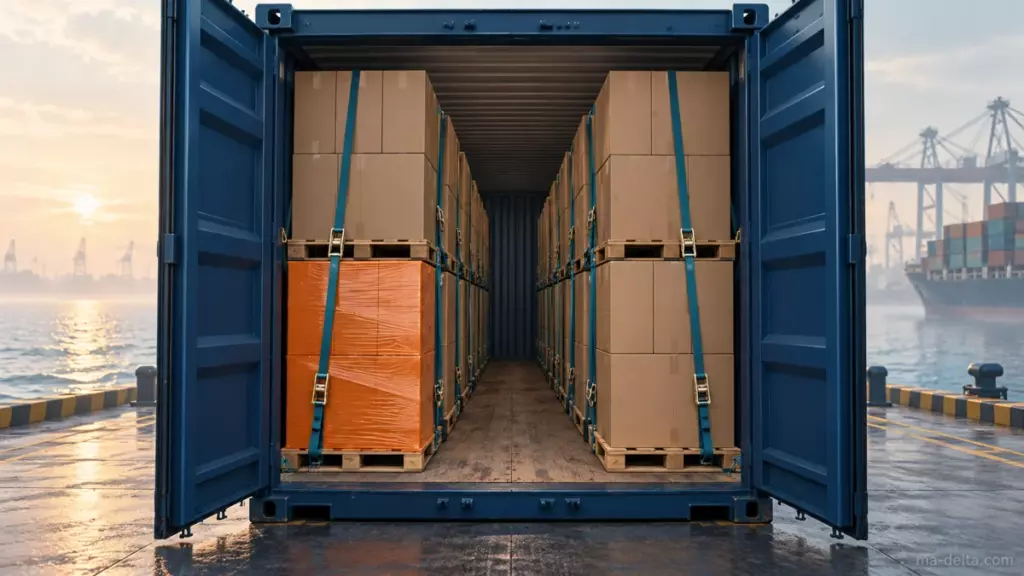
Illustration: Portolan
What matters to a shipper is the space inside. Steel walls, a wooden floor and the roof take up a few centimeters on each side, and the door frame is narrower still. The figures below come from the published specification of Hapag-Lloyd, one of the largest container lines, for its standard steel dry containers with wooden floors. Other owners’ boxes differ by a few millimeters.
| Measure | 20ft standard | 40ft standard | 40ft high cube |
|---|---|---|---|
| Internal length | 5,900 mm (19 ft 4 in) | 12,032 mm (39 ft 6 in) | 12,032 mm (39 ft 6 in) |
| Internal width | 2,352 mm (7 ft 9 in) | 2,352 mm (7 ft 9 in) | 2,342 mm (7 ft 8 in) |
| Internal height | 2,393 mm (7 ft 10 in) | 2,395 mm (7 ft 10 in) | 2,700 mm (8 ft 10 in) |
| Door opening, width | 2,340 mm (7 ft 8 in) | 2,340 mm (7 ft 8 in) | 2,340 mm (7 ft 8 in) |
| Door opening, height | 2,292 mm (7 ft 6 in) | 2,292 mm (7 ft 6 in) | 2,597 mm (8 ft 6 in) |
| Volume | 33.2 m³ (1,172 cu ft) | 67.7 m³ (2,391 cu ft) | 76.3 m³ (2,695 cu ft) |
Source: Hapag-Lloyd Container Specification, 03/2017; imperial figures converted by Portolan and rounded to the nearest inch; data as of October 2026
Two numbers in this table catch out first-time shippers. The door opening is lower than the internal height, so a crate that fits inside a high cube may still not pass through the doors if it is taller than 2,597 mm. And the volume is the empty space: cartons and pallets never fill it perfectly, which is why a load plan matters. We work through that calculation, carton by carton, in our guide to how many boxes fit in a shipping container.
How much weight can a shipping container hold?
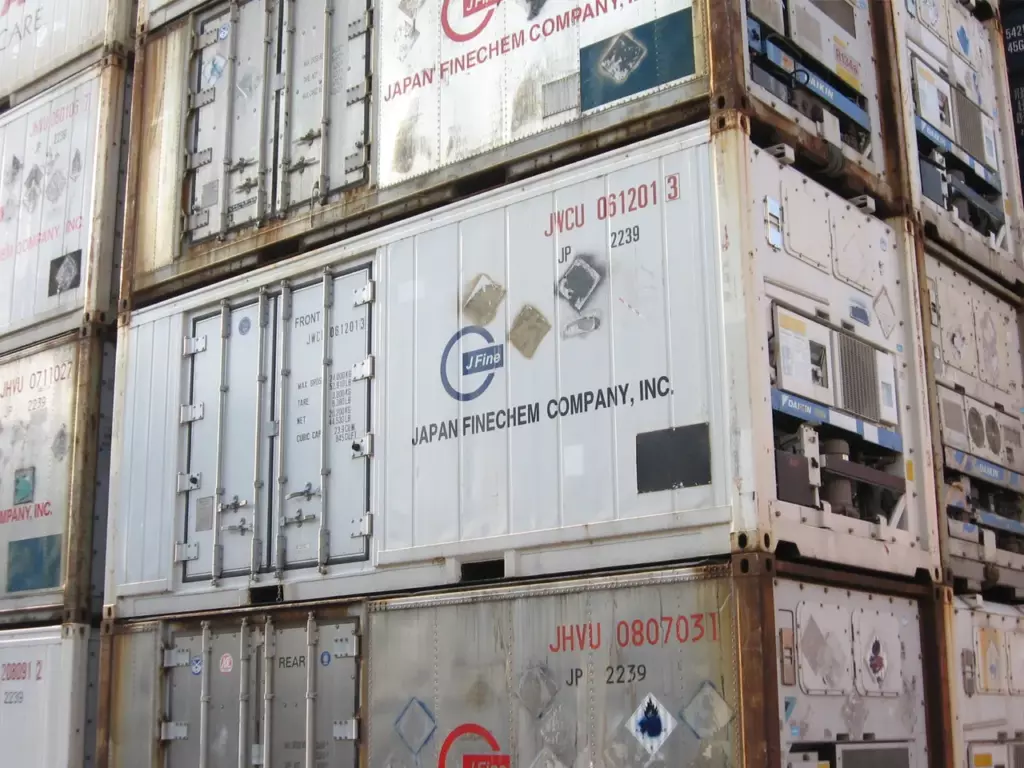
A 20ft refrigerated container with twin refrigeration units installed on both ends and externally powered side doors, owned by Japanese company Nippon Finechem. Photo: Gazouya-japan. Wikimedia Commons, Creative Commons Attribution-Share Alike 4.0 International license.
There are three different weights to keep apart. Tare is the weight of the empty container. Maximum gross mass is the most the container plus its cargo may weigh. Payload is the difference between the two, the cargo you can actually load.
| Weight | 20ft standard | 40ft standard | 40ft high cube |
|---|---|---|---|
| Tare | 2,300 kg (5,071 lb) | 3,700 kg (8,157 lb) | 3,850 kg (8,488 lb) |
| Maximum payload | 30,200 kg (66,580 lb) | 28,800 kg (63,493 lb) | 28,650 kg (63,162 lb) |
| Maximum gross mass | 32,500 kg (71,650 lb) | 32,500 kg (71,650 lb) | 32,500 kg (71,650 lb) |
Source: Hapag-Lloyd Container Specification, 03/2017; data as of October 2026
The standard itself allows more. ISO 668 rates most container sizes, 20ft and 40ft included, at a maximum gross mass of 30,480 kg in its basic table and permits ratings of up to 36,000 kg, according to the technical documentation of UIRR, the European association for combined road-rail transport. Each individual box is rated on its own data plate, and the lower of the plate rating and the carrier’s limit applies.
The real limit is often the road. On U.S. Interstate highways a truck may weigh no more than 80,000 lb (about 36,290 kg) in total, with 34,000 lb on a tandem axle group, under federal rules in 23 CFR 658.17. Once the tractor, the chassis and the box are counted, a container loaded close to its maximum gross mass will usually exceed that limit, so heavy cargo such as tiles or metal parts is often shipped in a 20ft box that is only partly full. Since 2016, the shipper must also declare a verified gross mass for every packed container before it is loaded onto a ship, under the SOLAS convention.
How to read the size code on the door
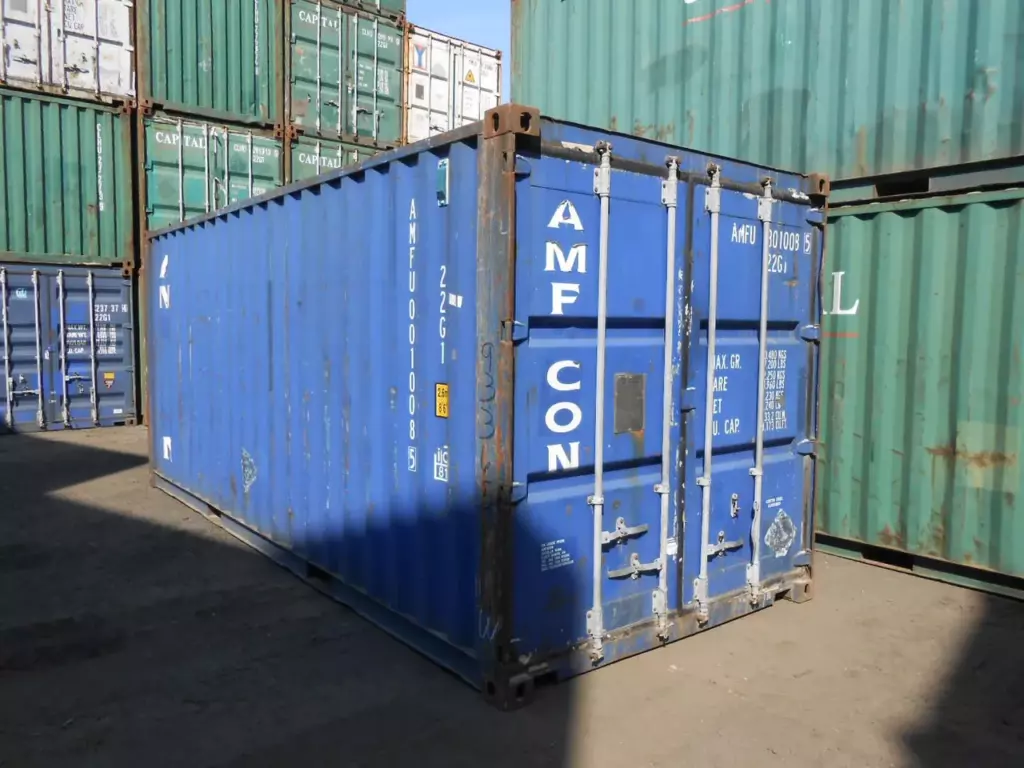
20 Foot Standard Height Cargo Shipping Container in Port Yard. Photo: IPLManagement. Wikimedia Commons, Attribution-Share Alike 4.0 International license.
Every container carries a four-character size and type code under its identification number, defined in the standard ISO 6346 and administered by BIC, the international container bureau. The first character is the length: 2 for 20 ft, 4 for 40 ft. The second is the height: 2 for 8 ft 6 in, 5 for 9 ft 6 in. The last two describe the type, with G1 for a general-purpose dry container.
So 22G1 is a standard 20ft dry box, 42G1 a standard 40ft and 45G1 a 40ft high cube. A refrigerated high cube appears as 45R1. Checking this code at pickup is the quickest way to confirm that the depot released the box you booked.
Did you know? Two 20ft containers placed end to end are 76 mm (3 in) shorter than one 40ft box, so a pair fits into a 40ft slot with room for the gap between them. Source: ISO 668 dimensions, calculation by Portolan.

Shipping container dimensions: FAQ
- Is a 40ft container twice the size of a 20ft? In length, almost: 12,192 mm against 6,058 mm. In volume, slightly more than twice, 67.7 m³ against 33.2 m³ in Hapag-Lloyd’s specification, because the 40ft has proportionally less wall and door. In payload, much less than twice: 28,800 kg against 30,200 kg, since the gross mass limit is the same. For heavy goods, two 20ft boxes carry more than one 40ft.
- How much bigger is a high cube? A 40ft high cube is 305 mm (1 ft) taller than a standard 40ft outside and inside, which adds about 8.6 m³ of space, roughly 13% more volume by our calculation. The width, length and floor area are the same. It suits light, bulky goods such as furniture or textiles.
- How many TEU is a 40ft container? Two. TEU, the twenty-foot equivalent unit, counts capacity in 20ft boxes, so a 40ft or a 40ft high cube counts as two TEU. Ship sizes are quoted the same way, and the largest container ships today carry more than 24,000 TEU, as our guide to the largest container ships explains.


