


Your supplier says the order comes to 700 cartons, each 55 by 45 by 40 centimeters, and the forwarder quotes a 40ft high cube. Will it all go in one container, or do you need a second box or an LCL shipment for the rest? The quick method most people try, dividing the container’s volume by the carton’s volume, says yes with room to spare. The cartons themselves say no.
For that carton, kept upright, a 40ft high cube holds 630, by our calculation, not the 770 that the volume shortcut suggests. The difference comes from the space that no carton can fill: the gap along each wall, the slice under the roof and the margin you need at the door. This guide shows how to count it step by step for cartons and pallets, how to check the weight, and what the international packing code says about where the heavy cargo goes.
How many boxes fit in a 40ft container?
It depends on the carton, so the only reliable answer is a count by rows and layers. Table 1 shows the result for one hypothetical carton of 550 x 450 x 400 mm (about 21.7 x 17.7 x 15.7 in) and 14 kg, packed upright, with a working margin of 100 mm at the doors and 50 mm under the roof.
Table 1. One carton type in three container sizes (hypothetical example)
| Container | Cartons per layer | Layers | Cartons | Volume used | Cargo weight | Volume shortcut says |
|---|---|---|---|---|---|---|
| 20ft standard | 52 | 5 | 260 | 77.5% | 3,640 kg | 335 |
| 40ft standard | 110 | 5 | 550 | 80.4% | 7,700 kg | 683 |
| 40ft high cube | 105 | 6 | 630 | 81.7% | 8,820 kg | 770 |
Source: our calculation using the internal dimensions and volumes of Hapag-Lloyd’s standard dry containers (specification 03/2017): 20ft 5,900 x 2,352 x 2,393 mm, 33.2 m³; 40ft 12,032 x 2,352 x 2,395 mm, 67.7 m³; 40ft high cube 12,032 x 2,342 x 2,700 mm, 76.3 m³.
Two details in the table are worth a second look. The high cube takes fewer cartons per layer than the standard 40ft, because its walls leave 10 mm less width, yet it carries 80 more cartons overall thanks to a sixth layer. And none of the three boxes is anywhere near its weight limit with this cargo. For light goods, space runs out first; for heavy goods such as tiles or machine parts, the payload does. The container sizes themselves are explained in our guide to 20ft, 40ft and high cube container dimensions.
How to calculate a container load, step by step
The method below works with a tape measure, the supplier’s packing list and a calculator. It gives a planning figure, which the warehouse that stuffs the container will confirm.
Step 1. Measure the carton and decide which way up it travels
Take the outside dimensions of a packed carton from the warehouse, since cartons bulge once filled and catalog sizes are often a few millimeters off. Then check the markings. A carton labeled “this side up”, or one holding glass or liquids, can be turned on the floor but not on its side, which fixes its height. Cartons without that limit can be laid in any direction, and that freedom often adds a few percent.
Step 2. Use the inside dimensions of the container
Every calculation starts from the internal size, which is several centimeters smaller than the outside in each direction. Container owners publish their own figures, and they differ by a few millimeters between fleets, so use the specification of the carrier that will supply your box when you can. Check the door opening too: in Hapag-Lloyd’s 40ft high cube it is 2,597 mm high, about 10 cm lower than the inside height.
Step 3. Count along the length, width and height
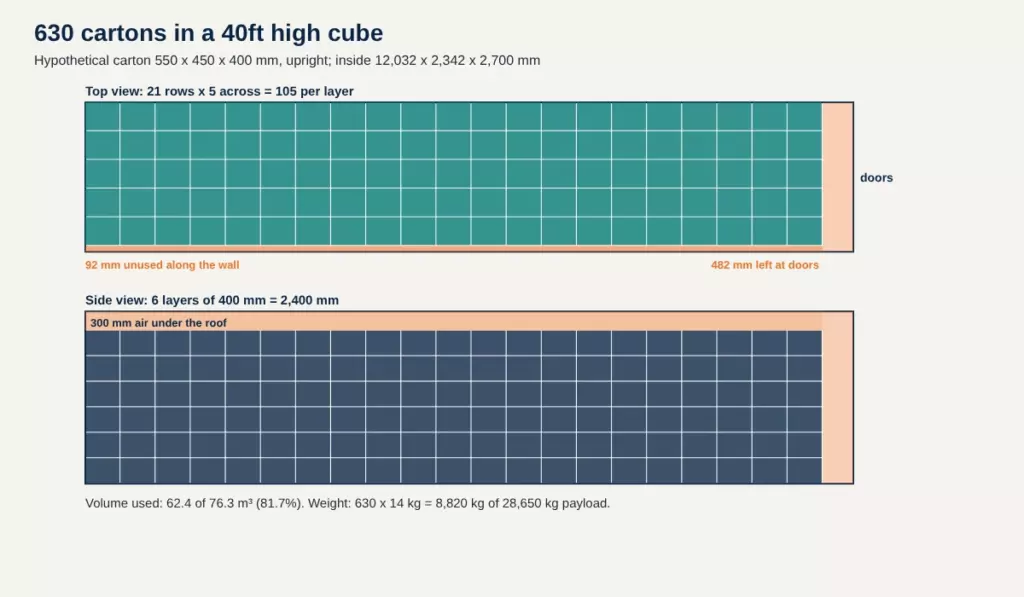
Diagram: Portolan, hypothetical example based on Hapag-Lloyd container specification 03/2017
Divide each internal dimension by the matching carton dimension and round down. In the 40ft high cube, with 100 mm left at the door, the length is 11,932 mm: that is 21 cartons at 550 mm. The width of 2,342 mm takes 5 cartons at 450 mm, and the height of 2,650 mm under the margin takes 6 layers of 400 mm. The result is 21 x 5 x 6 = 630 cartons.
Step 4. Try the other orientation for the leftover space
After the first count there is usually a strip of unused space along one wall. Turning the cartons 90 degrees in part of the load can fill it. In the 40ft standard box, for example, five cartons with the short side across fill 2,250 mm of the 2,352 mm width, for 105 cartons per layer. Four lanes that way use 1,800 mm, and the remaining 552 mm takes one more lane turned the other way: 4 x 21 + 1 x 26 = 110 cartons per layer, by our calculation. Load-planning software runs through these combinations automatically, but for one carton type a sketch on paper is enough.
Step 5. Check the weight
Multiply the number of cartons by the gross weight of one carton and compare the total with the container’s payload, the cargo weight it is rated for. Hapag-Lloyd rates its standard 40ft high cube at 28,650 kg of payload. If each of our cartons weighed 50 kg, the 630 that fit by space would weigh 31,500 kg, so the weight limit would cap the load at 573 cartons.
On the road the limit is often lower. On U.S. Interstate highways a truck may weigh no more than 80,000 lb (about 36,290 kg) in total under 23 CFR 658.17, so a container packed close to its maximum gross mass may need a lighter load or a special permit for the drayage to the warehouse.
Step 6. Keep a working margin
Nobody stuffs a container to the last millimeter. Cartons are pushed in by hand or forklift, walls are corrugated, and the last row by the door has to clear the door gaskets. Our example keeps 100 mm at the doors and 50 mm under the roof; that is our assumption for a planning figure, and a warehouse may ask for more for floor-loaded cargo or less for palletized goods.
How many pallets fit in a shipping container?

Diagram: Portolan, based on Hapag-Lloyd container specification 03/2017 and ISO 6780 pallet sizes
Pallets are counted the same way, on the floor only unless the goods allow double stacking. The two most common footprints are the European pallet of 1,200 x 800 mm used across Europe and the 48 x 40 in (1,219 x 1,016 mm) pallet common in North America; both are among the sizes listed in the international pallet standard ISO 6780.
| Pallet | 20ft standard | 40ft standard or high cube | Pattern |
|---|---|---|---|
| 1,200 x 800 mm | 11 | 25 | one lane lengthwise and one lane crosswise |
| 48 x 40 in (1,219 x 1,016 mm) | 9 | 20 | one lane each way |
Source: our calculation for one tier, using Hapag-Lloyd internal dimensions (03/2017); real figures can be lower if the pallets overhang or the load needs dunnage.
Did you know? A 2,352 mm wide container cannot take two 48 x 40 in pallets side by side with the 48 in side across, because that would need 2,438 mm, the full outside width of the box. The trick is to run one lane of pallets each way, which is why the North American pallet counts look uneven.
Popular online tables are more generous: the freight platform iContainers, for example, lists about 10 North American pallets for a 20ft box and up to 21 for a 40ft. With the inside dimensions above we could not fit more than 9 and 20 in one tier without overhang, so check such figures against your carrier’s specification and your own pallets before you rely on them.
Why the volume shortcut overestimates
Dividing 76.3 cubic meters by a carton of 0.099 cubic meters gives 770 cartons, but that assumes cartons can be sliced to fill every corner. In our example the waste comes from three places. Along the width, five cartons use 2,250 of 2,342 mm. Under the roof, six layers use 2,400 of 2,700 mm, leaving 25 cm of air. Along the length, 21 rows use 11,550 mm, plus the door margin. Together these gaps take about 18% of the volume.
Our 81.7% is a good result for a single carton size; an awkward size can do much worse, and mixed cartons usually do. When an order is close to the limit, the count by rows and layers decides. If the count falls well short of a full box, compare the cost with consolidation using our guide to whether FCL or LCL is cheaper for a small shipment.
Where should the heavy cargo go?

Illustration: Portolan
Low and in the middle. The IMO/ILO/UNECE Code of Practice for Packing of Cargo Transport Units (CTU Code) asks packers to spread the weight over the floor and keep the load’s center of gravity close to the middle of the container’s length, so that cranes, chassis and stacks are not loaded unevenly. A working rule quoted by container suppliers is that about 60% of the cargo weight should sit in the middle half of the length.
Heavy cartons go on the bottom, lighter ones on top, and a load that stops short of the doors needs blocking or bracing so it cannot slide. Floor strength has limits as well: Hapag-Lloyd’s weight distribution guideline gives the maximum load per running meter of floor, which matters for machinery and other heavy items that rest on a small area. Since 2016 the shipper has also had to declare a verified gross mass for every packed container under the SOLAS convention.
Before you book: five checks on your own load plan
- Measure a packed carton and confirm whether it may be turned on its side.
- Ask the forwarder for the internal dimensions and payload of the boxes in the carrier’s fleet.
- Count by rows and layers, try a second orientation, and compare with the volume shortcut.
- Multiply by the carton’s gross weight and check both the container payload and the road limit at destination.
- Make sure the carton count on the packing list matches the load plan, since customs and the carrier compare them; our import documents checklist shows what else must agree.

