


Your supplier says the goods are packed and asks where to send “the documents.” For a sea shipment into the United States or the European Union, the core set is short: a commercial invoice, a packing list, a bill of lading, an advance security filing made before the ship is loaded, and the customs entry made on arrival. When a container sits at the port for paperwork reasons, the cause is often that two of these papers tell different stories about the same box.
This guide walks through each document in the order you meet it, shows which fields have to agree across all of them, and ends with a checklist you can send to a supplier or a broker. Rules are given for US imports and, where they differ, for the EU. Data as of November 2026.
This article is for information only and is not legal, customs or financial advice. Customs rules, fees and filing systems change; check current official sources, your carrier and your customs broker before you ship. Data as of November 2026.
What documents do you need to import goods by sea?
Five are needed for almost every container, and a sixth group depends on the product. The supplier produces the first two, the carrier issues the third, and you or your broker file the rest.
Table 1. The core import document set for a sea shipment
| Document | Who prepares it | What it proves | When it is needed |
|---|---|---|---|
| Commercial invoice | Seller | What was sold, to whom, at what price, from which country | Before booking (draft), at customs entry (final) |
| Packing list | Seller | What sits in each carton or pallet, with weights and marks | With the invoice |
| Bill of lading (B/L) | Ocean carrier or forwarder | Receipt of cargo on board, contract of carriage, often the right to collect the goods | After loading |
| Advance security filing: ISF (US) or ENS (EU) | Importer or its agent (US); carrier, forwarder or importer (EU) | Who ships what to whom, before loading | At least 24 hours before loading at the foreign port |
| Customs entry and declaration | Importer or customs broker | Tariff classification, value, origin, duties due | On arrival |
| Product certificates, permits, licenses | Manufacturer, lab or importer | That the goods meet safety or agency rules | With the entry, for regulated goods |
Source: 19 CFR 141.86 (US commercial invoice), U.S. Customs and Border Protection, Hapag-Lloyd ICS2 guidance, CPSC. Data as of November 2026
Which party prepares the export side, the export declaration in China for example, depends on the delivery term in your contract. Under EXW the buyer carries that job; under FOB and CIF the seller does, which is one reason the choice of Incoterms rule belongs on the purchase order before production starts.
What must a commercial invoice include for US customs?
The commercial invoice is the document that sets your duty bill, so US regulations spell out its content in detail. Section 141.86 of Title 19 of the Code of Federal Regulations asks for the port of entry, the seller and buyer, a description detailed enough to classify the goods, quantities, the unit price and currency, the country of origin, and every charge that is or is not in the price.
Read as an importer, that list sorts into four questions customs wants answered. Who is the transaction between? What exactly is in the box, described by material and use rather than by a marketing name? What was paid, item by item, and in which currency? Where was it made? A pro forma invoice from the quotation stage does not answer them reliably: prices change after negotiation and quantities after production.
Two lines on the invoice cause disproportionate trouble. The first is charges. If the invoice shows a single figure “CIF Los Angeles,” the broker has to separate freight and insurance, because US duty is assessed on a value that excludes international freight, while the EU starts from a value that includes it. The second is assists, the regulation’s word for molds, tooling or designs the buyer supplied to the factory for free or at a discount. Their value belongs in the customs value even though it never appears in the price. Small importers who pay a factory separately for a mold are the ones most likely to miss it.
Did you know? The US invoice rule, 19 CFR 141.86, still asks importers to state the kind of currency paid, “whether gold, silver, or paper.”
For the EU, the content follows from what the customs declaration asks for, and the declarant needs the same facts: parties, description, value, currency, origin and the charges included in the price.
How is a packing list different from a commercial invoice?
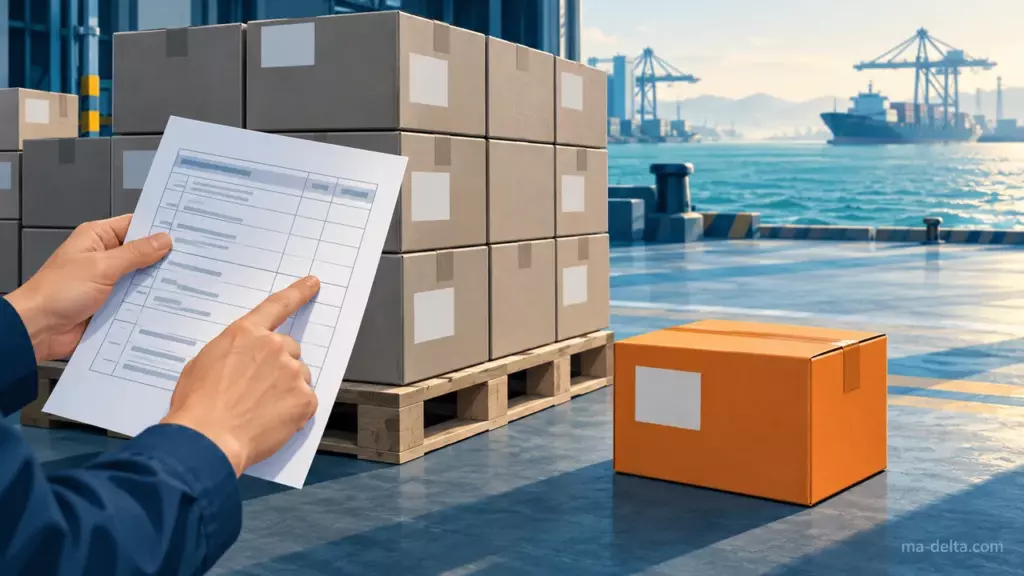
Illustration: Portolan
The invoice describes a sale; the packing list describes a load. It answers what is in carton 1 through carton 412, how much each carton weighs gross and net, its dimensions, and the shipping marks printed on its side. The US invoice rule itself says the papers must show in adequate detail what is in each individual package.
Customs uses the packing list when it decides to look inside. An officer picking cartons for an exam goes by the marks and numbers; if carton 37 is listed as phone cases and holds charging cables, the shipment stops being routine. The warehouse uses the same list to receive the goods, and an FBA or 3PL inbound will be checked against it carton by carton.
A good packing list is boring and exact. It shows one line per carton type, the number of cartons of each, units per carton, net and gross weight, carton size, total cubic meters (CBM) and the marks. The totals must equal the totals on the invoice and on the bill of lading. When a factory rounds weights on one document and not on another, the gap is enough to trigger questions.
Who holds the bill of lading decides who collects the box
The bill of lading is issued by the carrier, or by a forwarder acting as carrier, once the goods are on board. It is a receipt, the evidence of the contract of carriage, and, in its negotiable “to order” form, a document of title: whoever holds the original set can claim the cargo at destination. That is why sellers on payment terms keep the originals until the balance is paid. The types, from straight to negotiable and from master to house, are covered in our guide on how to read a bill of lading.
For an importer, three practical points matter more than the theory. The consignee and notify party on the B/L must match the importer on the customs entry. The cargo description is often shortened (“said to contain 412 cartons furniture”), and that is acceptable as long as it does not contradict the invoice. And the release method has to be settled before arrival: original bills mailed or couriered to you, a telex release where the seller surrenders the originals at origin, or a sea waybill that needs no original at all.
A few days before arrival, the carrier or forwarder sends an arrival notice with the vessel’s expected date, the terminal, the charges to pay before release and the free time. That last line matters most. Once free time runs out, storage and equipment charges start, and the reasons and remedies are explained in our article on demurrage and detention.
What must be filed before the ship leaves the foreign port?

Diagram: Portolan, based on CBP and EU ICS2 rules, 2026
Both the United States and the EU want to know what is coming before a container is loaded abroad, and the deadline is the same: 24 hours before loading at the port of origin.
In the United States this is the Importer Security Filing, known as “10+2” because the importer supplies ten data elements and the carrier two more. It names the seller, buyer, manufacturer, ship-to party, consolidator, container stuffing location, country of origin and the six-digit Harmonized System (HS) code, among others. CBP can claim liquidated damages of up to $5,000 per violation for a late, inaccurate or missing ISF, according to CBP’s guidance as reported when enforcement began.
The EU equivalent is the Entry Summary Declaration (ENS) in the Import Control System 2 (ICS2). Since the maritime phase started on June 3, 2024, the ENS for containers must carry a six-digit HS code, a full cargo description, the EORI number of the EU consignee and buyer and seller details. A forwarder can file its own house-level data separately from the carrier. Missing or late data can mean the box is not loaded at all, the “do not load” message carriers warn about in their ICS2 guides.
The practical consequence: your supplier’s data must reach your broker or forwarder before the goods reach the port. Many ISF penalties start with a factory that ships first and sends the paperwork later.
Where do mismatches between documents come from?
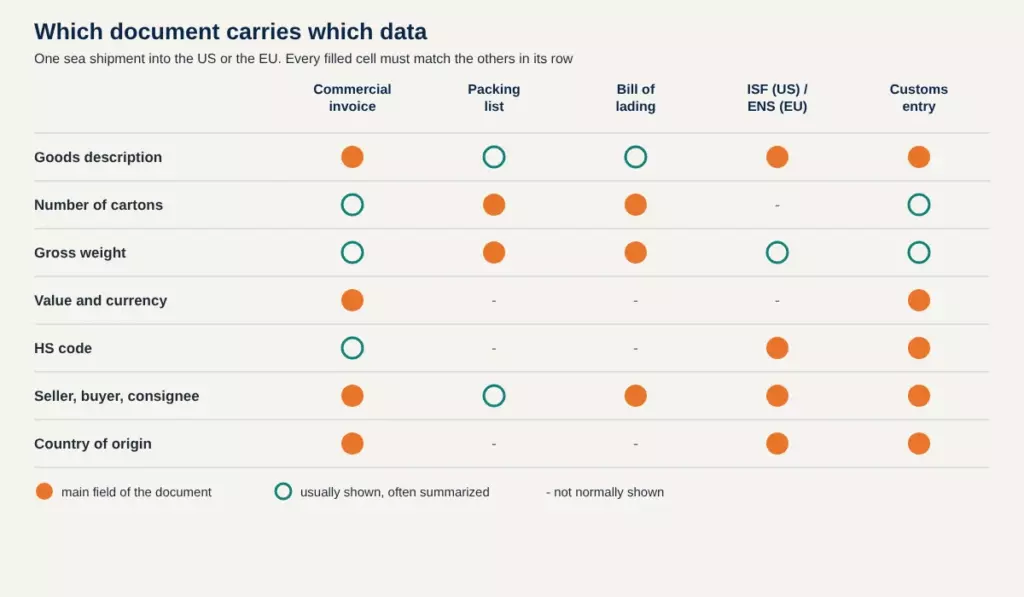
Diagram: Portolan, based on 19 CFR 141.86, CBP and ICS2 carrier guidance, 2026
Almost always from one of five fields that appear on several documents: the description, the quantity, the weight, the value and the parties. The diagram shows where each of them lives.
Typical stories behind a hold look like this. The invoice was revised after a price discount, but the ISF was filed from the first draft. The packing list shows 412 cartons; the B/L says 410 because two were added at the factory after the booking was confirmed. The factory’s export declaration in China used one HS code and your broker another. The weight on the B/L came from the truck scale at the depot and the packing list from the factory’s estimate. Each is innocent; together they look like a shipment nobody understands.
Value is where errors become expensive. To show the scale, take a hypothetical container of furniture bought for $37,400 FOB, the same example we use in our Incoterms comparisons. The US merchandise processing fee on that entry is 0.3464% of value, $129.55, and the harbor maintenance fee another 0.125%, $46.75. A single ISF violation can cost up to $5,000, about 39 times the processing fee and 13% of the value of the goods. Duties themselves come on top, and how they are worked out from the invoice value is the subject of our step-by-step guide on calculating import duty.
Which filings and certificates come with the customs entry?
The customs entry is where the documents above turn into a legal declaration. In the United States, the entry documents must be filed within 15 calendar days of the shipment’s arrival, and the entry summary, CBP Form 7501, with estimated duties within 10 days of release, according to CBP. Most small importers do this through a licensed customs broker, who needs a power of attorney from you before filing anything.
Every formal entry also needs a customs bond, a guarantee that duties and penalties will be paid. A single-entry bond covers one shipment; a continuous bond covers a year. Under CBP’s bond guidelines, the minimum continuous bond is $50,000 or 10% of the duties, taxes and fees paid in the previous 12 months, whichever is higher. For anyone importing more than a few containers a year, the continuous bond usually ends up simpler.
Behind the entry sit agency requirements that depend on the product. A notable change came in 2026: from July 8, 2026, importers of consumer products covered by a US Consumer Product Safety Commission (CPSC) rule must file certificate data electronically with the entry, whatever the size of the shipment. The filing covers seven elements, including the product identifier, the safety rule cited, the date and place of manufacture and the testing laboratory. Toys, children’s furniture and many clothing items are among the roughly 600 HTS codes CPSC flagged first. Food, cosmetics and medical devices go through the Food and Drug Administration instead.
On the EU side, the importer needs an EORI number before any declaration is lodged, and the customs declaration itself is filed by the importer or an indirect representative in the member state of import. Import VAT is due at that point unless the country offers postponed accounting.
A certificate of origin is not usually part of a standard US entry for goods from China; origin is stated on the invoice and checked against the product. It becomes necessary when a trade agreement or a specific trade measure requires proof.
A document checklist for the next container
Send this list to your supplier with the purchase order, and to your broker or forwarder when the booking is confirmed:
- Incoterms rule and named place written on the purchase order and the invoice.
- Draft commercial invoice: buyer and seller with full addresses, description by material and use, HS code suggestion, unit price, currency, country of origin, charges shown separately, payment for molds or tooling listed.
- Packing list: one line per carton type, carton count, units per carton, net and gross weight, dimensions, total CBM, shipping marks.
- ISF data (US) or ENS data (EU) sent to the filer at least three working days before the cargo leaves the factory, so the 24-hour deadline is met with a margin.
- Bill of lading draft checked before issue: consignee, notify party, carton count and weight match the packing list.
- Release method agreed: originals, telex release or sea waybill.
- Customs bond and power of attorney in place with the broker; EORI number for the EU.
- Product certificates ready for regulated goods, including CPSC eFiling data for covered consumer products.
- Arrival notice read the day it arrives: free time, terminal and charges noted.
- Final invoice, packing list and B/L compared side by side before the entry is filed.
The last step takes ten minutes and catches most of the problems described above. If the three documents agree on what is in the box, how much it weighs and what it cost, the customs side of the shipment is usually the least eventful part.

