

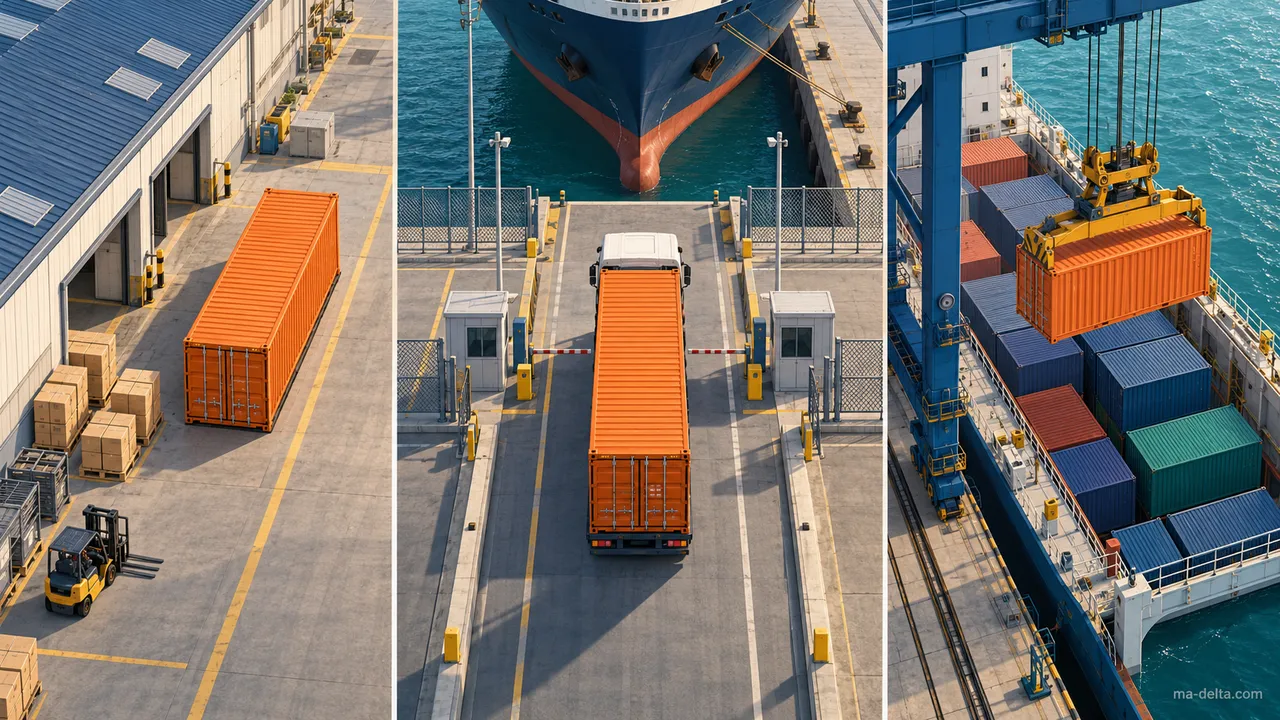
Three emails arrive on the same morning from the same furniture factory near Ningbo. The first quotes $36,500 for a 40-foot high cube container “EXW”. The second, $37,400 “FOB Ningbo”. The third, $43,900 “CIF Los Angeles”. The goods are identical. What changes is who books the truck, the export declaration and the ship, and who carries the loss if something goes wrong on the way.
For most buyers sourcing in China the short answer is FOB, with your own freight forwarder booking the ocean leg. EXW looks cheapest and usually is not; CIF looks complete and often leaves the most expensive part of the bill for the end. Below we take the three quotes apart line by line, with the numbers marked as hypothetical where they are.
This article is for information only and is not legal, customs or financial advice. Duties, rates and rules change; check current official sources, your carrier and your customs broker. Data as of October 2026.
What do EXW, FOB and CIF mean on a China quote?
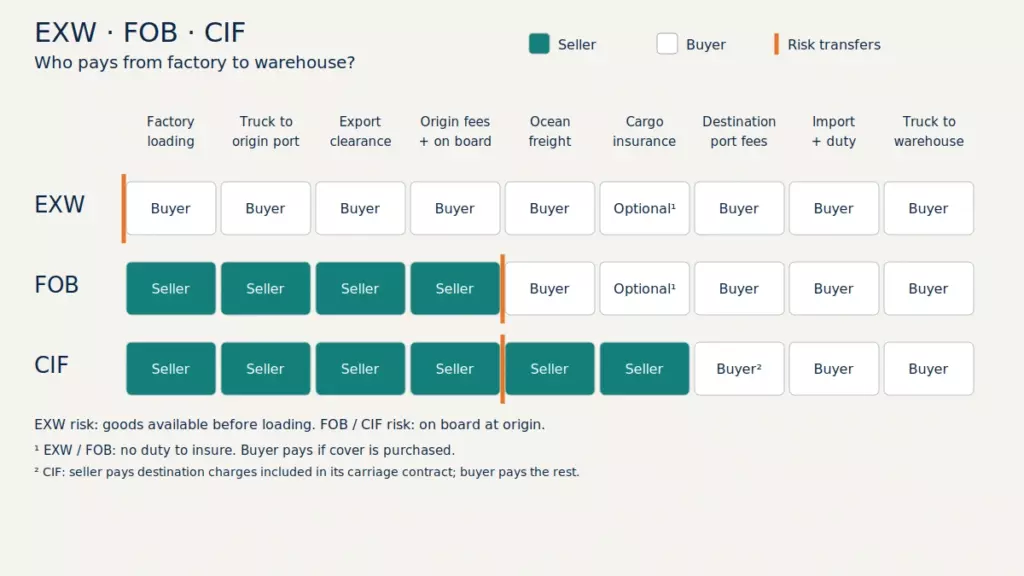
Diagram: Portolan, based on ICC Incoterms 2020, 2026
All three are Incoterms rules, the three-letter terms published by the International Chamber of Commerce that split costs, tasks and risk between seller and buyer. Each one answers two questions: where the seller’s job ends, and at what point damage to the cargo becomes the buyer’s problem. Our guide to all 11 Incoterms 2020 rules covers the full set; here we stay with the three that dominate Chinese price lists.
Under EXW, ex works, the seller makes the goods available at its own premises and does almost nothing else. Under FOB, free on board, the seller clears the goods for export and delivers them on board the ship you nominate at the named Chinese port; from that moment the voyage is yours. Under CIF, cost, insurance and freight, the seller also pays the ocean freight and a basic insurance policy to your port. The risk, however, still passes to you in China, when the goods are loaded. That last point surprises many first-time importers: a CIF price buys you a paid ticket, and the cargo travels at your risk all the same.
One order, three prices
Here is how the three quotes from our opening break down. The factory, the order and every figure except the freight benchmark are hypothetical, chosen to show the method.
Table 1. One 40-foot high cube container from a factory near Ningbo to Los Angeles, three ways (hypothetical quotes)
| Line | EXW quote | FOB Ningbo quote | CIF Los Angeles quote |
|---|---|---|---|
| Goods at the factory | $36,500 | $36,500 | $36,500 |
| Truck to port, export declaration, origin terminal charges | paid by you | $900 in the price | $900 in the price |
| Ocean freight to Los Angeles | paid by you | paid by you | $6,350 in the price |
| Cargo insurance, minimum cover | paid by you | paid by you | $150 in the price |
| Total quoted | $36,500 | $37,400 | $43,900 |
| Charges at Los Angeles, customs, duty, truck to warehouse | paid by you | paid by you | paid by you |
Source: hypothetical quotes; for comparison, the Drewry World Container Index spot rate from Shanghai to Los Angeles was $8,007 per 40-foot container on October 22, 2026
The $900 gap between EXW and FOB is the seller’s price for the Chinese part of the trip. On this order it is small, and a factory that trucks containers to Beilun every week usually does it cheaper than a foreign buyer’s agent could.
The interesting gap is the next one. The CIF quote carries $6,350 for freight, $1,657 below the Drewry spot benchmark for the busier Shanghai lane on the same date. A seller with a long-term contract rate might really beat the spot market. On our reading, a price this far under the index is a signal to ask what the carrier or the seller’s forwarder will charge you at the destination before the box is released.
Where does the CIF price hide its cost?
Illustration: Portolan
Under CIF the seller picks the carrier and, in practice, the forwarder, and the seller’s contract with them ends at your port. Everything after that is billed to you by a company you did not choose: terminal handling at destination, document and release fees, sometimes “agency” charges with vague names. Logistics consultants have warned since at least 2011 that some forwarders offer exporters cheap or even rebated freight and recover the money through steep charges to the importer at arrival, according to a 2011 post by Renaud Anjoran, a quality control consultant based in China, who cited the head of a forwarding company. Those fees can be negotiated only before you agree the term; once the container sits on the quay, there is nothing left to bargain with.
The insurance is the second weak spot. Incoterms 2020 requires a CIF seller to buy only minimum cover, the Institute Cargo Clauses (C), for at least 110% of the contract price. Clauses (C) list a narrow set of major casualties such as fire, stranding or sinking; theft, rough handling and water damage from a leaking container are typically outside them. Because the risk on the ocean is already yours, that thin policy is in fact protecting your own goods. Our explainer on marine cargo insurance compares the clauses side by side.
The third cost is control. A CIF seller has no reason to pick the fastest sailing or the most reliable carrier for you, only the cheapest one that meets the letter of credit or the contract. When the shipment is late, you have almost no say with the carrier.
Why EXW is rarely the cheapest option from China
EXW wins on paper because it is the lowest number. In China it also hands the buyer a task it often cannot perform. Export declarations are lodged by an export consignor registered with Chinese customs, and registration requires a Chinese market entity with a foreign trade operator filing, according to the Shanghai government’s guide to customs registration. A foreign buyer usually has neither. In practice the factory or a hired agent still files the declaration, so the buyer pays someone to do what an FOB seller would have done anyway.
Loading is the other trap. Under EXW the seller is not obliged to load the container onto your truck. The factory’s forklift usually does it, but if a pallet falls during loading the loss is legally yours. Add the collection truck, an export agent’s fee and the risk of missing the vessel’s cut-off, and the $900 saving from our table can disappear quickly.
EXW does make sense in a few cases: when you consolidate goods from several suppliers in one warehouse, when your forwarder has a strong office in China, or when you buy from a trading company that has no export license of its own. In each case, ask the seller to load the container and to provide the export documents, and write that into the purchase order.
Does the Incoterm change your import duty?
The term never changes the duty rate, which comes from the product’s tariff classification. It can change the value the rate is applied to.
The U.S. customs statute defines the price for duty as the payment for the goods “exclusive of any costs” of transport and insurance for the international shipment. Source: 19 U.S.C. 1401a(b)(4)(A).
In the United States, the price used for customs value excludes the costs of transport and insurance for the international leg, under 19 U.S.C. 1401a(b)(4)(A). An FOB invoice already starts from that base. A CIF invoice works too, as long as freight and insurance appear as separate lines with documents to back them; a single lump sum for “CIF Los Angeles” invites duty on the freight as well. In the European Union the logic runs the other way: customs value includes transport and insurance up to the point where the goods enter the Union, under Article 71 of the Union Customs Code. An EU importer buying FOB adds the freight when declaring, so the duty base ends up close to the CIF value either way.
For a full calculation with real tariff lines for both markets, see our guide on how to calculate import duty on goods from China.
FOB, CIF or EXW: when to choose which
- Choose FOB for most container orders when you have a forwarder you trust. You see the real freight cost, you pick the sailing and you know the destination charges in advance.
- Accept CIF only for small or occasional orders, and only after you ask for a written list of destination charges and upgrade the insurance to Institute Cargo Clauses (A) or buy your own.
- Use EXW when goods from several factories meet at one consolidation point, and agree in writing that the seller loads and handles export clearance.
- Consider FCA at the factory or the container terminal if your contract allows it. It matches how containers move, and the ICC itself recommends it for container cargo.
Whatever you pick, write the full place and the edition into the purchase order, for example “FOB Ningbo, Incoterms 2020”. The term settles who pays for the first and middle parts of the trip; what the whole journey costs and how long it takes is the subject of our guide to shipping from China by sea.

