


Many first-time importers believe that the code printed on the supplier’s invoice settles the matter. The supplier knows the product, the code has the right number of digits, and the shipment cleared last time. It is the most expensive assumption in customs. The code an exporter puts on its paperwork is written for its own country’s export rules, and the duty, the extra tariffs and any penalty at destination fall on the importer.
This guide explains how the code is built, how to classify a product step by step, where to check your answer in the United States and the European Union, and what a wrong code can cost, with the legal limits and one court case as examples. Data as of November 2026.
What is an HS code?
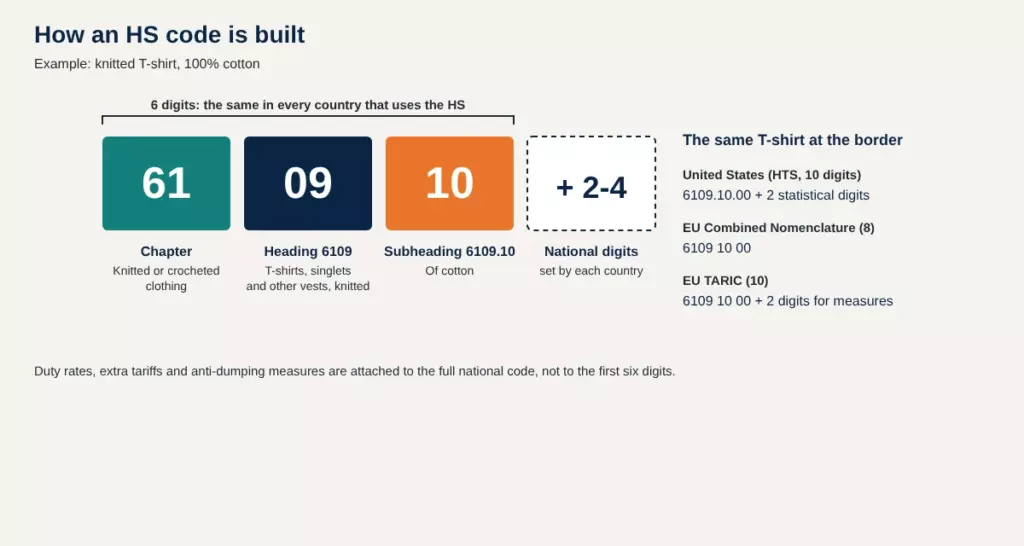
Diagram: Portolan, based on the WCO Harmonized System, USITC HTS and EU Combined Nomenclature
The Harmonized System, or HS, is the international product classification maintained by the World Customs Organization (WCO). It is used by more than 200 countries and economies, and more than 98% of the merchandise in international trade is classified in its terms, according to the WCO. Each product group has a six-digit code that means the same thing at every border that uses the system.
The six digits come in three pairs. The first two give the chapter, the first four the heading, and all six the subheading. Countries then add digits of their own: the United States uses 10 digits in its Harmonized Tariff Schedule (HTS), and the EU uses 8 in its Combined Nomenclature and 10 in TARIC, its integrated tariff database, where anti-dumping duties and other measures are attached.
Take a knitted cotton T-shirt. Chapter 61 covers knitted or crocheted clothing, heading 6109 covers T-shirts, singlets and other vests, knitted, and subheading 6109.10 narrows it to cotton. In the US tariff the line is 6109.10.00, with two statistical digits added on the entry; in the EU it is 6109 10 00. The rate is attached to the full national code, so two products that share six digits can still pay different duties.
Is the supplier’s HS code good enough?
As a starting point, yes; as the answer, no. A Chinese, Indian or Turkish exporter classifies goods under its own national tariff, which shares only the first six digits with yours. Even those six can differ, because classification is a legal judgment and two customs services can reach different conclusions on the same product. In the United States the customs law, 19 U.S.C. 1484, puts the duty to use reasonable care on the importer of record, and a code copied from a supplier does not move that duty to anyone else.
The terms of sale matter too. Under some Incoterms rules the seller arranges import clearance, under others the buyer does, and the party that files the declaration answers for the code. How the rules divide that work is set out in our guide to the 11 Incoterms rules.
How to classify a product, step by step
Classification follows a fixed order set out in the General Rules for the Interpretation of the Harmonized System, which every member country applies. The steps below follow that order.
Step 1. Describe the product as customs will see it
Write down what it is made of, what it does, how it works and how it is sold. For a mixed product, note the share of each material by weight or value. A description such as “home goods” or “parts” cannot be classified; “knitted T-shirt, 100% cotton, for men” can.
Step 2. Find the chapter and heading by their wording
Read the section and chapter titles to narrow the field, then read the headings themselves. The first rule says that classification is decided by the terms of the headings and the legal notes to sections and chapters. Titles are only a guide, and the notes often exclude products that seem to fit.
Step 3. Apply the later rules only if the first one does not decide
The second and third rules deal with unfinished goods, sets and products made of several materials. When two headings could apply, the more specific description wins; if that does not decide, the material or part that gives the product its essential character decides; and as a last resort the heading that comes last in numerical order is used. The fourth rule covers goods that fit nowhere, the fifth deals with cases and packing, and the sixth applies the same logic at the level of subheadings.
Step 4. Check the national tariff
With six digits in hand, open your destination’s tariff: the USITC’s Harmonized Tariff Schedule for the United States, TARIC for the EU. Pick the national line, note the general duty rate and read the footnotes for any additional duties. In the United States, extra tariffs such as those under Section 301 on goods from China are listed by HTS code, as our guide to calculating import duty on goods from China shows step by step.
Step 5. Search earlier rulings
Customs services publish their decisions. CBP’s Customs Rulings Online Search System (CROSS) and the EU’s European Binding Tariff Information database (EBTI) let you see how similar products were classified, with the reasoning. A ruling issued to another company does not bind customs in your case, but it shows how customs reads the tariff.
Step 6. Ask for a binding decision when the stakes are high
For a new product line or a large contract, ask customs in advance. In the United States, binding rulings are issued under 19 CFR Part 177, and electronic classification requests are generally answered within about 30 days, according to the trade law firm Great Lakes Customs Law. In the EU, a Binding Tariff Information decision is normally valid for three years from the date of issue, according to Ireland’s Revenue, and its reference must be quoted on the customs declaration.
What does a wrong HS code cost?

Illustration: Portolan
The first cost is the duty itself. A well-known US case shows the gap that a few digits can make. In January 2003 the Court of International Trade ruled that Toy Biz’s Marvel action figures were toys and not dolls, because the figures represented non-human creatures; dolls then paid 12% duty and toys 6.8%. On a hypothetical $50,000 shipment, that is $6,000 against $3,400, a difference of $2,600, by our calculation.
The second cost is the penalty. Under 19 U.S.C. 1592, a classification error caused by negligence can bring a civil penalty of up to two times the lost duties, taxes and fees; gross negligence up to four times; and fraud up to the domestic value of the goods. On our hypothetical shipment, negligence alone could add up to $5,200 to the $2,600 owed. The same law rewards early correction: an importer who reports the error before customs opens an investigation, a so-called prior disclosure, pays in a negligence case only the interest on the unpaid duty.
Table 1. What a wrong code can cost in the United States
| Item | Limit under 19 U.S.C. 1592 | Hypothetical shipment, $2,600 of lost duty |
|---|---|---|
| Unpaid duty | the difference between the rates | $2,600 |
| Penalty for negligence | up to 2 times the lost duties, taxes and fees | up to $5,200 |
| Penalty for gross negligence | up to 4 times the lost duties, taxes and fees | up to $10,400 |
| Penalty for fraud | up to the domestic value of the goods | up to the full value |
| After prior disclosure (negligence) | interest on the unpaid duty | interest only |
Source: 19 U.S.C. 1592(c), via Cornell Law School’s Legal Information Institute; hypothetical shipment and figures by our calculation using the rates in Toy Biz v. United States (2003).
The other costs are harder to price. A wrong code can trigger a licensing or safety requirement that the right one would not, or miss one that applies, which can hold the shipment at the port while storage charges run. For sellers who ship to fulfillment warehouses under delivered duty paid terms, a code error on one product repeats on every shipment, a risk we return to in our article on Amazon FBA shipping from China.
What changes in HS 2028?
The system is updated every five to six years. On January 21, 2026 the WCO accepted 299 sets of amendments for the next edition, which takes effect on January 1, 2028. Among them, human and other vaccines move to two new headings, 30.07 and 30.08; dietary supplements get their own heading, 21.07; and the subheadings for plastic waste are restructured to follow the Basel Convention, according to the WCO.
For importers, the practical effect is a review of every code in the product catalog before 2028. Codes that stay the same keep their rates; codes that move may change duty, quotas or licensing, and old rulings tied to deleted lines can lose their value.
Common HS code mistakes and how to avoid them
- Copying the supplier’s code without checking it against your own national tariff.
- Classifying by product name and skipping material, function and the legal notes.
- Stopping at six digits when the rate and extra duties sit at 8 or 10.
- Ignoring the chapter notes, which often exclude the very product that seems to fit.
- Using one code for a mixed shipment of different products to save time on the invoice.
- Keeping an old code after a tariff update, such as the 2028 edition of the HS.
- Not correcting a known error, when a prior disclosure in the United States can cut the penalty to interest.
The cheapest classification is the one done before the goods are ordered. A day spent with the tariff and the rulings databases, or a binding ruling for a large line, costs less than one corrected entry.

