

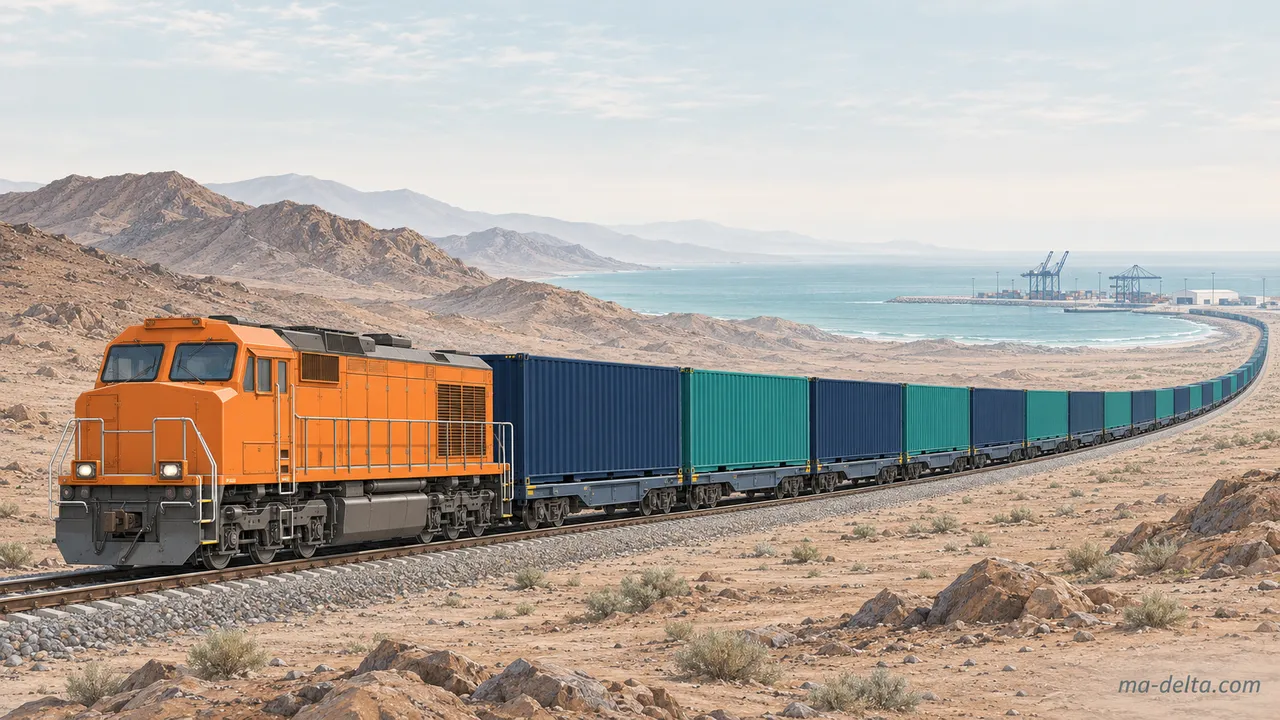
For an Indian exporter, the International North-South Transport Corridor is a working route with a weak link at the Indian end. Cargo can leave Mumbai by ship, cross Iran by rail or truck and reach Russia by Caspian vessel or train. In 2026, though, the sea leg from India has become the hard part: shipping to Iran’s southern ports has been severely restricted since the conflict involving the United States, Israel and Iran began in late February, and the US sanctions waiver that covered India’s terminal at Chabahar ended on April 26, 2026. This guide follows the route leg by leg, sets out what India has built and signed, and lists what a shipper should check before booking. Data as of November 2026.
How does cargo move from Mumbai to Russia on the INSTC?
In three or four handovers. A container ship or general cargo vessel takes the goods from Mumbai or Nhava Sheva across the Arabian Sea to an Iranian port: Shahid Rajaee at Bandar Abbas, Iran’s main container gateway, or Chabahar on the Gulf of Oman. From there the cargo crosses Iran by rail or truck and then takes one of three paths into Russia: a ship from a Caspian port such as Anzali or Amirabad to Astrakhan or Makhachkala, a train through Turkmenistan and Kazakhstan, or a train and truck through Azerbaijan via the border town of Astara.
[Image: 36-route-map.webp | alt: “Schematic map of the INSTC route from Mumbai by sea to Chabahar and Bandar Abbas, by rail across Iran and on to Russia by the Caspian Sea, the eastern railway or the western route via Astara” | caption: “Map: Portolan, based on government and railway data, status October 2026”] The whole corridor, from St Petersburg to Mumbai, is about 7,200 km, according to Russian energy minister Sergei Tsivilev, who co-chairs Russia’s intergovernmental commission with Iran (February 2026). The Russian rail operator has published transit times for the eastern branch only: a train from the Moscow region reached Bandar Abbas in nearly 16 days and one from the Chelyabinsk region in 11 days, Dmitriy Kryukov of RZD Logistics said in February 2025. Russian Railways moved 11,000 containers on the corridor in 2025, up from 7,200 a year earlier, its chief executive Oleg Belozerov told TASS.
Each Caspian port on the way has its own depth and season, compared in our guide to Caspian Sea ports.
Is the INSTC faster than the Suez route for India?
On paper, yes. The Indian news magazine The Week gave about 25 days from Mumbai to St Petersburg by the corridor against about 40 days through Suez in December 2025, without naming a source. Former Indian navy chief Admiral Sunil Lanba, quoted in the same article, put the savings at about 30% on cost and 40% on time compared with the traditional route.
We read these figures as estimates from supporters of the corridor. We found no carrier or forwarder timetable that guarantees a door-to-door time over the whole route, and every handover adds a wait: a port transfer in Iran, a border crossing, a change of rail gauge and, on the western branch, a truck between Astara and Rasht until the 162 km railway gap is closed. The structure of the route and the state of that gap are explained in our guide to the International North-South Transport Corridor.
What does India run at Chabahar?
A container and general cargo terminal. India Ports Global Limited (IPGL), a state company, has operated the Shahid Beheshti terminal at Chabahar since 2018 through its subsidiary India Ports Global Chabahar Free Zone, according to India’s Minister of State for External Affairs Kirti Vardhan Singh, answering in parliament on July 31, 2026. A 10-year contract with Iran’s Ports and Maritime Organization was signed on May 13, 2024. India committed $120 million under that contract and paid the final tranche in August 2025, the minister said.
Chabahar matters to India for its location. It lies on the Gulf of Oman, outside the Strait of Hormuz, and it was meant to give Indian cargo a route to Afghanistan and Central Asia that avoids Pakistan, as India Seatrade News noted in September 2025. The missing piece was a railway inland. On September 25, 2026 Iran said it had finished the 730 km line from Chabahar to Zahedan, with full running expected three to four months later, as India Shipping News reported.
Did you know? The Chabahar-Zahedan line has 39 tunnels and 201 bridges over its 730 km, according to the Iranian announcement reported by India Shipping News (September 2026).
Timeline: India and the corridor
Table 1 lists the steps that shaped the Indian end of the route.
Table 1. India and the INSTC: main dates
| Date | Event | Source |
|---|---|---|
| 2000 | Russia, Iran and India sign the corridor agreement in St Petersburg | intergovernmental agreement |
| 2014 | Kazakhstan-Turkmenistan-Iran railway opens, creating the eastern branch | railway operators |
| 2018 | IPGL begins operating the Shahid Beheshti terminal at Chabahar | Indian Ministry of External Affairs, July 2026 |
| May 13, 2024 | 10-year Chabahar operating contract signed | Indian Ministry of External Affairs, July 2026 |
| September 29, 2025 | US revocation of the Chabahar sanctions exception takes effect | US State Department, September 2025 |
| October 2025 | Conditional US waiver granted until April 26, 2026 | Indian Ministry of External Affairs, January 2026 |
| Late February 2026 | Shipping to Iran’s southern ports severely restricted | Lloyd’s List Intelligence, October 2026 |
| April 26, 2026 | Conditional waiver ends | Indian Ministry of External Affairs, July 2026 |
| September 25, 2026 | Iran completes the Chabahar-Zahedan railway | India Shipping News, September 2026 |
Source: as listed in each row; status as of November 2026.
What should an Indian shipper check before booking?
Illustration: Portolan
The corridor still carries freight, and trade between the two countries keeps growing: India-Russia trade reached a record $68.69 billion in the 2025-2026 fiscal year, India’s Commerce Secretary Amardeep Singh Bhatia told TASS in July 2026. Much of that value is crude oil carried by tanker, outside the corridor. For containers and general cargo, the practical checks are these:
- Which Iranian port the quote assumes. Bandar Abbas and Chabahar face different restrictions in 2026, and a change of port changes the whole inland leg.
- Which branch into Russia. Caspian ship, eastern railway or western road-and-rail each has its own border crossings, and the Caspian leg depends on the season and the water level.
- Sanctions screening. Iranian ports, carriers and banks are covered by US and other sanctions, and the end of the Chabahar waiver removed a shield that covered the Indian-run terminal. The checks an importer should run are set out in our guide to sanctions compliance in shipping.
- Insurance and payment. Ask whether the cargo policy covers every leg, including war risks at sea, and how the buyer will pay, since banking links with Iran are limited.
- Transit time in writing. Ask the forwarder for a door-to-door estimate with each handover listed, and compare it with the all-sea option around Suez or the Cape.
What the corridor means for India in 2026
India has done its part of the paperwork and paid its share at Chabahar, and Iran has finished the railway inland. What has not changed is the risk at the sea end. Until shipping to Iran’s southern ports returns to normal and the sanctions question at Chabahar is settled, the route from Mumbai to Russia will suit cargo that can wait, accept several handovers and clear sanctions checks. For everything else, the long sea route remains the default.

