

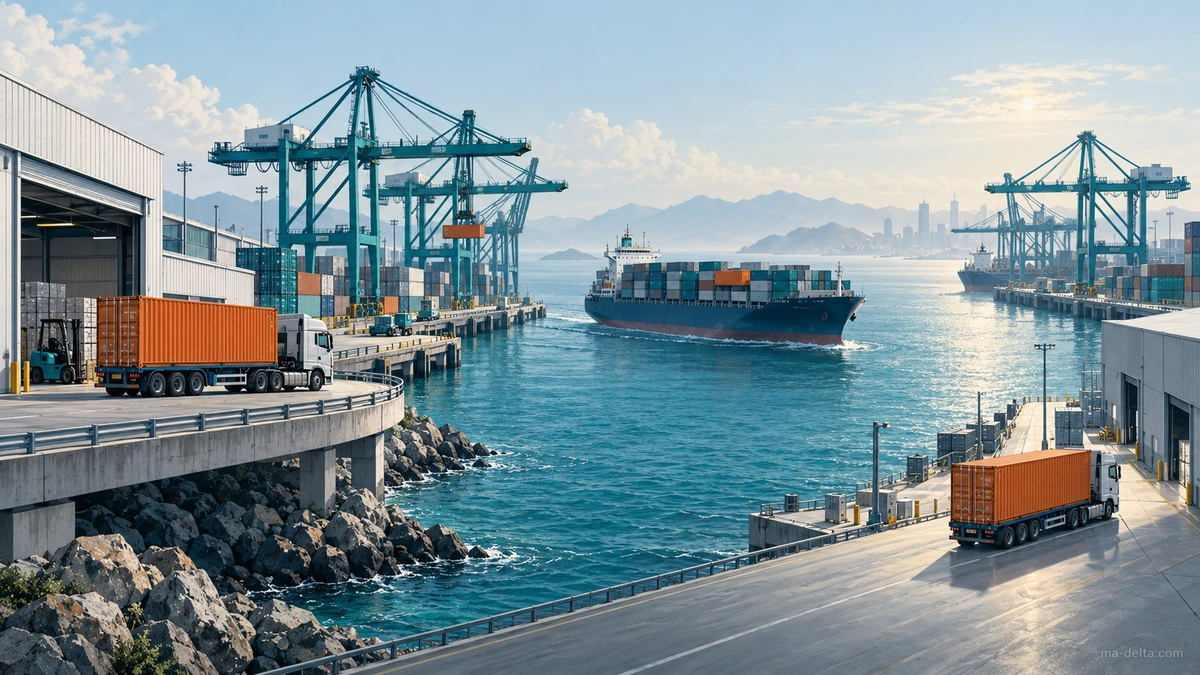
14 to 18 days. That is how long a container usually spends at sea between Shanghai and Los Angeles on a scheduled service, according to typical liner schedules for mid-2026 compiled by the logistics software firm GoFreight. To New York through the Panama Canal it takes 30 to 35 days, and to Rotterdam through the Suez Canal about five weeks once the ship has made its usual port calls. Add three to seven days for customs and trucking at each end, and a real order from a Chinese factory reaches a US or European warehouse in roughly three to seven weeks after it leaves the factory gate.
The price of the trip changed more in 2026 than the time. Ocean freight from Shanghai to Los Angeles cost $8,007 per 40-foot container on October 22, 2026, according to the Drewry World Container Index, and U.S. duties on Chinese goods were rebuilt twice during the year after a Supreme Court ruling. This guide walks one shipment from the factory to the warehouse: the routes, the ports, the paperwork and every line of the bill, with a worked example for the United States and one for the European Union.
This article is for information only and is not legal, customs or financial advice. Duties, rates and rules change; check current official sources, your carrier and your customs broker. Data as of October 2026.
How long does shipping from China take by sea?
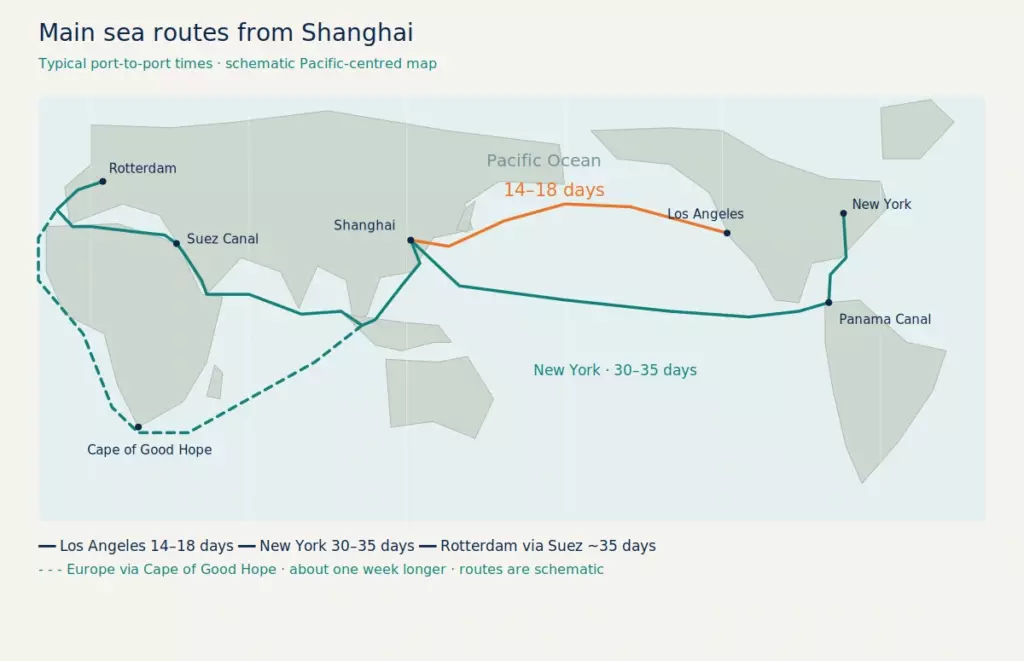
Diagram: Portolan, based on GoFreight, Port Economics, Management and Policy and Metro Global, 2026
The sea leg is only one part of the clock. A typical door-to-door shipment has four stages: preparing and trucking the cargo to the Chinese port, the voyage, unloading and customs at the destination, and delivery to your warehouse. The voyage dominates, so the route matters most.
Table 1. Typical transit times from China by sea, autumn 2026
| Route | Port to port | Door to door, approximate |
|---|---|---|
| Shanghai to Los Angeles / Long Beach | 14-16 days | 17-25 days |
| South China (Yantian) to Los Angeles / Long Beach | 15-18 days | 18-25 days |
| Shanghai to New York / Newark, via Panama | 30-35 days | 33-42 days |
| South China to Savannah or Houston, via Panama | 33-40 days | 36-47 days |
| Shanghai to Rotterdam, via Suez, with port calls | about 35 days | 38-45 days |
| Shanghai to Rotterdam, around Africa | about 7 days more than via Suez | 45-52 days |
Source: GoFreight liner schedule summary (July 2026); Port Economics, Management and Policy (routing distances); Metro Global analysis of carrier networks (October 2026); door-to-door ranges calculated by Portolan by adding 3-7 days to port-to-port times. Data as of October 2026
Two things stretch these numbers in practice. Schedule reliability, the share of ships that arrive on the day the carrier promised, was about one in two in late summer 2026: 49.9% in August and 50.6% in September, according to the Danish analysts Sea-Intelligence, with late ships running more than six days behind. And the Europe route is in flux. After two years in which most Asia-Europe services sailed around the Cape of Good Hope, carriers began returning to the Red Sea and Suez in the second half of 2026; by late October about 63% of Far East-Europe capacity used the canal again, and the returning services cut about seven days on average, according to an October 27 analysis by Metro Global. Some carriers still route around Africa, so ask which way your sailing goes before you promise a delivery date.
Air freight is far faster and costs many times more per kilogram, so it suits samples and urgent restocks. Rail from China to Europe sits between air and sea in both time and price. For full container loads of ordinary goods, sea freight stays the default.
Which Chinese port should you ship from?
Usually the one nearest your factory, because every extra kilometer of trucking inside China adds cost and a day of risk. The ports mostly serve their own regions: Shanghai and Ningbo-Zhoushan cover the Yangtze River Delta, Shenzhen’s Yantian and Shekou and the port of Guangzhou serve the Pearl River Delta, and Qingdao and Tianjin handle the north. Our guide to the ports of China compares them in detail.
The exceptions are worth knowing. A factory in an inland province may have a choice of two gateways, and the busier one usually has more direct sailings, which can save a transshipment and several days. A small port near the factory may offer only feeder services to a hub, adding a week. Before you sign, ask the supplier which port they normally use and ask your forwarder how many direct weekly services leave from it to your destination.
On the other side the choice is wider than many first-time importers think. In the United States, Los Angeles and Long Beach are the fastest gateway from Asia and the main door to the West and Midwest, while cargo for the East Coast can sail directly to New York-New Jersey or Savannah or cross the country by rail from California. In Europe, Rotterdam, Antwerp-Bruges and Hamburg are the main deep-sea gateways for cargo from China, and goods for Central Europe often continue by barge or train.
The shipment step by step, from order to warehouse
Illustration: Portolan
A shipment fails most often at the handover points, where one company passes the box to the next. Here is the sequence, with the deadlines that cost money when they are missed.
- Terms and booking. The Incoterm in your purchase order decides who books the ship. Under FOB, the most common term for China, you or your forwarder book the ocean leg, usually one to two weeks before the cargo is ready; the trade-offs between FOB, CIF and EXW are explained in our comparison of FOB, CIF and EXW for China imports.
- Inspection and loading at the factory. A pre-shipment inspection by a third party catches problems while they can still be fixed. The empty container is delivered to the factory, loaded, sealed and trucked to the terminal before the carrier’s cut-off time.
- Export clearance in China. The supplier or its agent files the export declaration. A container that misses customs clearance or the cut-off waits for the next ship, often a week later.
- Security filings before loading. For the United States, the importer must file the Importer Security Filing (ISF, also called “10+2”) at least 24 hours before the container is loaded in China; U.S. Customs and Border Protection can claim liquidated damages of up to $5,000 per violation. For the European Union, the carrier and, for many consolidated shipments, the forwarder submit safety and security data in the ICS2 system before loading.
- The voyage. Your forwarder sends the bill of lading, the document that proves who owns the cargo and controls its release; keep the original or telex release instructions safe.
- Arrival and customs. Your customs broker files the import entry, pays duties and fees on your behalf and clears the goods. Terminal handling and document fees are billed at this point.
- Delivery and return of the empty box. A trucking company collects the container from the terminal and returns the empty one. Carriers allow a few free days; after that, demurrage (for a box left in the terminal) and detention (for a box kept outside it) are charged per day.
Every one of these steps is also described from the container’s point of view in our walk-through of how container shipping works.
Rule of thumb: the factory’s “ready date” is not your ship date. Allow a week between the end of production and loading for inspection, trucking and the carrier’s cut-off, and another few days if the port is congested.
How much does it cost to ship a container from China?
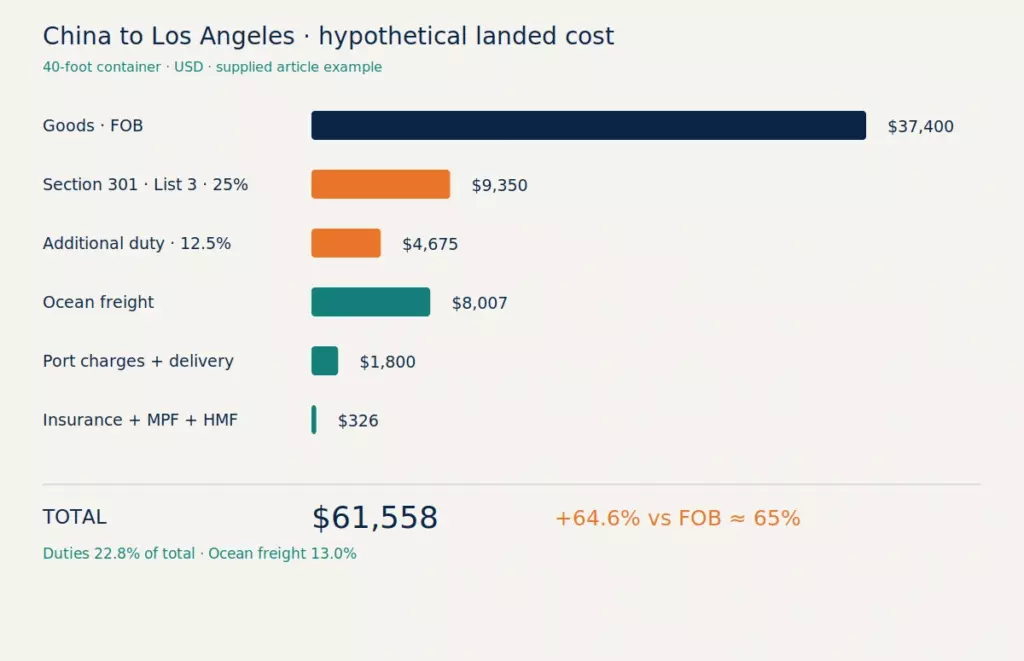
Diagram: Portolan, hypothetical example; freight rate from Drewry WCI, October 22, 2026
The ocean freight is the most visible number and rarely the largest one after the goods themselves. Spot rates for a 40-foot container from Shanghai on October 22, 2026 looked like this.
Table 2. Spot ocean freight from Shanghai, 40-foot container, October 22, 2026
| Destination | Rate, US dollars per 40ft | Change on the week |
|---|---|---|
| Los Angeles | 8,007 | +2% |
| New York | 10,166 | +1% |
| Rotterdam | 3,632 | +3% |
| Genoa | 4,152 | +5% |
| Drewry composite, eight lanes | 4,585 | +2% |
Source: Drewry World Container Index via Cyprus Shipping News, data as of October 2026
Two patterns stand out. The transpacific lanes cost two to three times as much as Asia-Europe that week; on our reading, the return of ships to the shorter Suez route has freed capacity and weighed on Europe rates. And spot rates move weekly: a week later, on October 29, the Los Angeles rate had fallen 6% to $7,514. How to read these benchmarks, and why the Shanghai and Drewry figures differ, is the subject of our explainer on freight indexes.
Freight is only one line. A full calculation, called landed cost, adds origin charges if your term does not include them, insurance, destination charges at the port, trucking, duties and fees. To show the proportions, we built a hypothetical example: a container of goods bought FOB Ningbo for $37,400, classified on Section 301 List 3 with a 0% normal duty rate and not covered by Section 232, shipped to Los Angeles at the October 22 spot rate.
The result is $61,558, or 65% above the FOB price. By our arithmetic, duties take 22.8% of the total and ocean freight 13%. For a U.S. importer of Chinese goods in 2026, the tariff line is the one to model first, because it is larger than the freight and harder to change once the goods are on the water.
What duties apply to Chinese goods in the US and the EU?
United States, status on October 31, 2026
U.S. duties on Chinese goods are built in layers, and 2026 rearranged them. On February 20, 2026, the Supreme Court ruled in Learning Resources, Inc. v. Trump that the International Emergency Economic Powers Act (IEEPA) does not authorize tariffs; Customs stopped collecting the “fentanyl” and “reciprocal” tariffs on February 24, and refunds were sent back to the Court of International Trade to resolve. A temporary 10% surcharge under Section 122 of the Trade Act followed for 150 days. On July 24, 2026, a new Section 301 duty for forced-labor concerns took effect, at 12.5% for goods of China, according to U.S. Customs and Border Protection guidance issued the day before.
Table 3. Main layers of U.S. import duty on goods from China, October 2026
| Layer | Rate | Applies to |
|---|---|---|
| Normal (MFN) duty | 0% to over 30% | every product, by its 10-digit HTS code |
| Section 301, Lists 1-3 (since 2018-2019) | 25% | listed products |
| Section 301, List 4A | 7.5% | listed products |
| Section 301 increases since 2024 | 25% to 100% | selected goods such as electric vehicles, batteries, solar cells |
| Section 301, forced labor (since July 24, 2026) | 12.5% | most goods of China, except goods under Section 232 and other exemptions |
| Section 232 | 10% to 50% | steel, aluminum, copper, vehicles, wood products and other covered goods |
| Merchandise processing fee | 0.3464% of value, with a minimum and maximum per entry | formal entries |
| Harbor maintenance fee | 0.125% of value | cargo arriving by sea |
Source: U.S. Customs and Border Protection, CSMS message of July 23, 2026; DLA Piper (Supreme Court ruling, February 2026); broker summaries of current Section 301 rates. Data as of October 2026
The broker guides we reviewed add the 12.5% on top of the older Section 301 list rates, so a List 3 product pays 37.5% plus its normal duty; confirm the stacking for your HTS code with your customs broker before you price an order. The duty is charged on the customs value, which in the United States excludes international freight and insurance, so it is calculated on the FOB price, not on the landed cost. Two more items are moving. After the September 2026 summit between the two presidents, Washington and Beijing published lists of goods, worth about $30 billion of each side’s imports, to be considered for lower tariffs, with no rates or dates announced by the end of October. And the duty-free treatment of shipments worth up to $800, known as de minimis, has been suspended for all countries since August 29, 2025, so even small parcels from China pay duty.
European Union
The European Union has not added China-wide surcharges of this kind. Duty depends on the product’s code in TARIC, the EU’s tariff database, and many industrial goods pay a few percent; some Chinese products also carry anti-dumping duties, which TARIC shows by code. The customs value in the EU includes freight and insurance up to the EU border, and import VAT, at standard rates from 17% in Luxembourg to 27% in Hungary according to the European Commission’s 2026 list, is charged on top of the value plus duty.
Here is the same hypothetical container landed in Rotterdam, assuming a 2.7% duty rate and the Dutch standard VAT of 21%. The customs value is $41,182 (goods, $3,632 freight and $150 insurance), the duty $1,112 and import VAT $8,882. A VAT-registered business normally recovers the VAT, so the real cost added by the border is the duty, about 2.7% of the customs value in this example. For low-value e-commerce parcels the EU removed its €150 duty exemption on July 1, 2026 and introduced a flat €3 duty per item, according to the Swedish Customs Service; a full container is not affected.
Our step-by-step guide on how to calculate import duty on goods from China works through real tariff lines for both markets.
FCL, LCL or Amazon FBA: which way to ship a small order?
A full container load (FCL) is the cheapest per unit once your goods fill most of a 40-foot box, which offers about 68 cubic meters of space. Below that, less than container load (LCL) lets you pay for your share of a box that a consolidator fills with other shippers’ goods. LCL is priced per cubic meter, takes longer because the box is packed and unpacked at warehouses on both ends, and adds handling charges that make it expensive for shipments close to half a container.
The break-even point depends on the lane and the week, so ask for both quotes once your order passes about 15 cubic meters. Sellers on Amazon face a further choice: ship to their own warehouse or a third-party logistics firm and send stock to Amazon in stages, or ship straight to Amazon fulfillment centers under the marketplace’s appointment and labeling rules. The options, including delivered duty paid (DDP) services offered by Chinese forwarders, are compared in our guide to Amazon FBA shipping from China.
Which costs surprise importers most?
The freight quote is the number everyone compares, and the surprises come from the lines around it. These five are worth asking about before you sign.
- Destination charges under CIF terms, billed by a forwarder you did not choose and negotiable only before the goods arrive.
- Demurrage and detention when customs holds a box for inspection or the trucking company cannot collect it within the free days.
- Peak season and emergency surcharges announced by carriers with a few weeks’ notice and applied to bookings already made.
- Exam fees: if U.S. Customs picks a container for inspection, the importer pays for trucking it to the exam site and for the handling.
- Wrong tariff classification, which can mean back duties and penalties years after the goods were sold.
Each of these can be priced or limited in advance with a written quote and a broker who checks the HTS code before the order is placed.
Takeaways for first-time importers, regular shippers and FBA sellers
If this is your first container, buy FOB, hire a forwarder and a customs broker before the goods are ready, and calculate the landed cost with the current duty layers for your exact HTS code. In the U.S. example above, duties added more to the bill than the freight did.
If you ship regularly, the biggest gains are in timing and contracts. Book two weeks ahead, watch the weekly freight indexes to choose when to fix rates, and track the Suez return on Asia-Europe lanes, which may shorten transit by about a week on some services and push rates down as capacity is freed.
If you sell on Amazon, plan for the door-to-door times in Table 1 plus Amazon’s own receiving time before stock goes live, and treat a cheap DDP quote with care: ask who files the U.S. entry and in whose name the duties are paid.

