


By late October 2026 about 63% of container capacity between the Far East and Europe was sailing through the Suez Canal again, according to an October 27 analysis by Metro Global, after two years in which most of it went around Africa. The return reminded shippers how much a single waterway is worth. They had a sharper lesson in March 2021, when one container ship, the Ever Given, wedged itself across the canal and held up an estimated $9.6 billion of trade a day.
The Ever Given story is usually told as a viral image: a giant hull, a small excavator. For cargo owners it is a case study in what a blocked chokepoint does to delivery times, who pays for the rescue and how long goods can stay stuck after the ship itself is free. Some of the cargo on board reached its buyers months late. Here is how that happened, day by day and then month by month.
What happened to the Ever Given in the Suez Canal?

Satellite image of the Ever Given lying diagonally across the Suez Canal in March 2021. Photo: Contains modified Copernicus Sentinel data [2021], processed by Pierre Markuse. Wikimedia Commons, Creative Commons Attribution 2.0 Generic license.
The ship was one of Evergreen’s G-class, roughly 400 meters long and 58.8 meters wide, built to carry more than 20,000 TEU, in the same size bracket as the largest container ships afloat. Its legal structure was typical of modern liner shipping and mattered for what came next. The owner was Shoei Kisen Kaisha, the shipowning arm of Japan’s Imabari group. Evergreen Marine of Taiwan operated it under a long-term time charter, the arrangement compared in our guide to time, voyage and bareboat charters. Bernhard Schulte Shipmanagement was its technical manager. It flew the flag of Panama and carried a crew of 25.
Who was at fault was later argued between the Suez Canal Authority (SCA) and the owner’s side, and the dispute ended in a confidential settlement. We do not take a side on the causes. What follows is what the blockage did to trade.
Six days in the canal: the rescue step by step
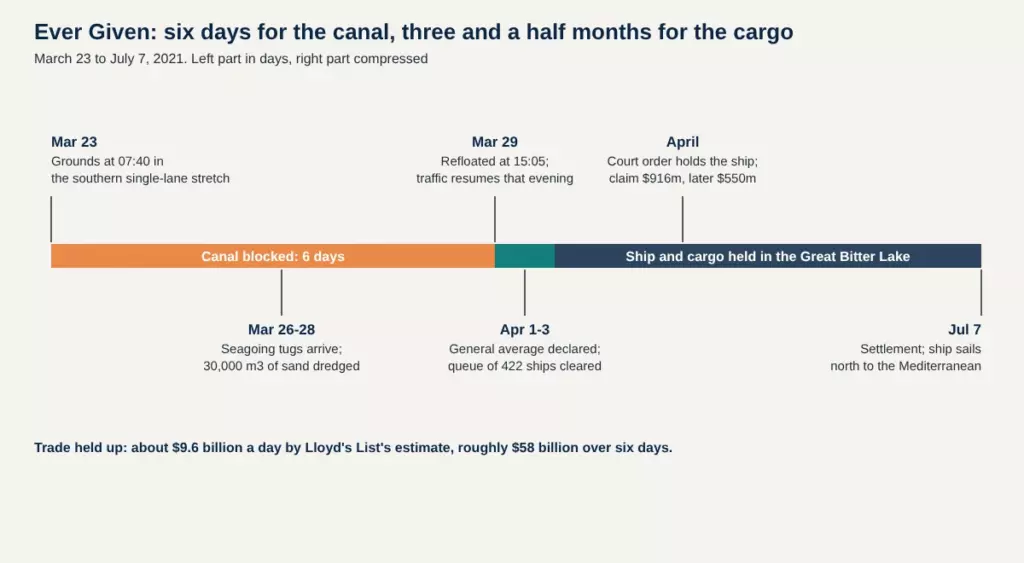
Diagram: Portolan, based on Suez Canal Authority, Boskalis, Lloyd’s List and court reports, 2021
The first days went to digging. Dredgers worked around the bow while tugs pushed and pulled at high tide, with little result: a loaded ship of this size resting on sand does not move until the sand under it is removed. Dredgers in the channel and excavators on the bank cut into the shore around the bow.
By the weekend the salvage team, led by SMIT Salvage of the Dutch group Boskalis, had brought in two seagoing tugs, Alp Guard and Carlo Magna, to add to eleven harbor tugs. About 30,000 cubic meters of sand were removed from around the bow, according to Boskalis.
At 15:05 local time on March 29 the ship was free. It was towed north to the Great Bitter Lake, the wide natural basin in the middle of the canal, for inspection. Traffic resumed the same evening, and the SCA ran convoys of extra length to clear the queue.
Did you know? After it was freed, the Ever Given spent 100 days in the Great Bitter Lake, more than 16 times as long as it had blocked the canal.
How much trade did the Ever Given blockage hold up?
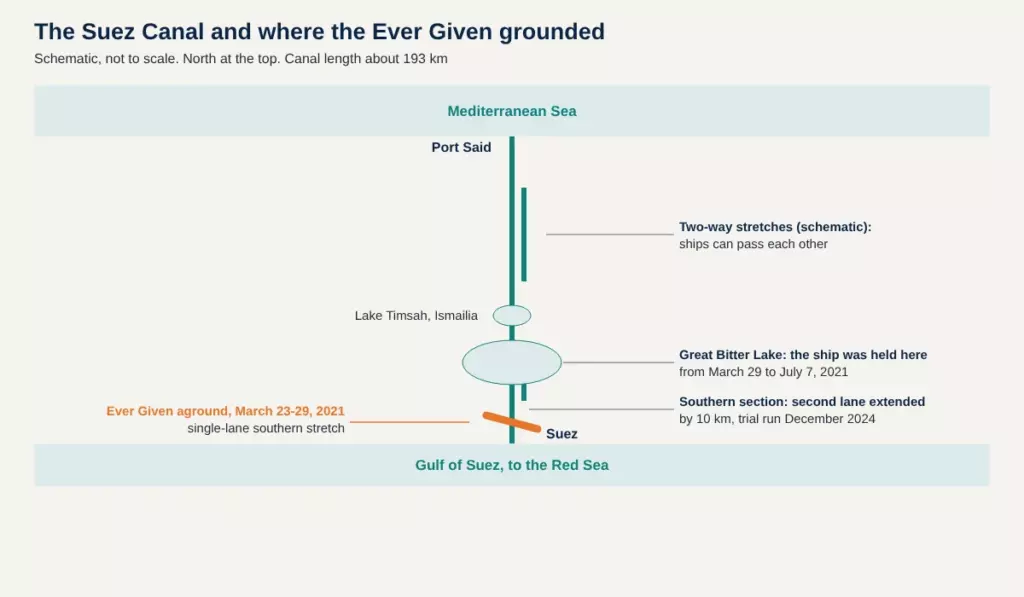
Diagram: Portolan, based on Natural Earth and Suez Canal Authority data
The headline number came from Lloyd’s List, which estimated the value of goods passing through the canal at about $5.1 billion a day westbound and $4.5 billion eastbound, so about $9.6 billion of trade was held up for each day of closure. The publication itself called these rough calculations. Other estimates landed in the same range: Port Economics, Management and Policy, an academic reference site, put it at about $9 billion a day.
Most of the goods were undamaged. The cost to shippers came from lateness: components missing from assembly lines, seasonal goods arriving after the season, ships and containers out of position for the following weeks. Spread over six days, the Lloyd’s List estimate means roughly $58 billion of goods were held up in transit for some period.
The queue grew to 422 ships, according to the SCA’s count of vessels stranded between March 23 and 29. The authority cleared it by Saturday, April 3, when the last 61 waiting ships went through together with 24 new arrivals.
Some owners did not wait. According to Port Economics, Management and Policy, 27 ships turned around and took the route around the Cape of Good Hope, adding 7 to 10 days of sailing, and their arrival times ended up about the same as if they had stayed in line. For cargo on those ships, the extra fuel bought certainty about the arrival date, and little else.
Who paid for the Ever Given rescue?
Illustration: Portolan
The cargo owners did, in part, through a centuries-old rule of maritime law. On April 1, 2021, Shoei Kisen declared general average, according to gCaptain. Under general average, when a ship’s owner spends money or sacrifices property to save a voyage, everyone with an interest in that voyage, including every owner of cargo on board, shares the cost in proportion to the value they had at stake. The mechanism and its arithmetic are the subject of our article on general average.
In practice the declaration meant that no container could be released at destination until its owner had provided security: a general average bond and a guarantee from an insurer or a cash deposit. The adjuster appointed was Richards Hogg Lindley. For uninsured shippers the deposit could be large. As a reference, in the 2018 Maersk Honam fire the adjuster asked for salvage security of 42.5% of cargo value and a general average deposit of 11.5%, so a shipper with $100,000 of goods would have needed $54,000 to get them back. An insured shipper simply passed such a request to the insurer.
This is the part of the story most importers missed in 2021, and it is the most useful lesson. Marine cargo insurance covers general average contributions; without it, a shipper whose goods are perfectly undamaged can still be asked for cash before release.
Why was the Ever Given held in Egypt for three months?
Because the SCA sued for compensation and an Egyptian court ordered the ship detained while the claim was pending. The authority initially claimed $916 million, then reduced the demand to $550 million. The owner and its insurers disputed the claim, and the ship waited in the Great Bitter Lake with its crew and cargo still aboard.
The parties reached a settlement in early July. Its terms were not disclosed; local reports said the canal would also receive a tug. On July 7, 2021, the day after an Egyptian court lifted the detention order, the Ever Given sailed north toward the Mediterranean, according to CNBC. Its cargo reached European ports more than three months later than planned.
For shippers this was the costliest phase. Goods meant for spring sales arrived in summer. Cargo owners had no contract with the canal authority and no say in the dispute; their only practical tools were the ones they had arranged before loading, above all insurance.
What changed in the Suez Canal after the Ever Given?
Egypt’s response was to add capacity in the stretch where the ship grounded. In May 2021 the SCA announced a project to widen and deepen the southern section and to extend the second, parallel channel at the southern end. In late December 2024 the authority ran a trial of a new 10-kilometer extension of the double lane, which brought the two-way section in that part of the canal from 72 to 82 kilometers, according to Marine Insight. Where ships can pass each other, one grounded vessel no longer closes the waterway.
In the trade the episode had a more lasting effect on contracts and habits than on infrastructure. Shippers who had not insured their cargo learned what general average means. And the six days in March 2021 became the reference case for later disruptions in the Red Sea: when shipping lines began routing around Africa at the end of 2023, the comparison everyone reached for was the cost of a closed canal. Why ships made that detour and how they are returning is covered in our article on Suez and Bab el-Mandeb.
Days for the canal, months for the cargo
The canal was closed for six days. The ship was free after six days, held for another 100 and back in service that summer. For the owners of the containers aboard, the delay was counted from March to July.
The gap between those numbers was not decided by the salvors, who did their job in under a week. It was decided by insurance, by the bill of lading and by the contracts behind the ship, which is where a cargo owner can still act before the next blockage.


