


On July 25, 1953, at the Howaldtswerke shipyard in Hamburg, a girl of about two and a half pressed a button and sent a bottle of champagne against the hull of a new tanker. Her five-year-old brother had started the launching mechanism. The children were Christina and Alexander Onassis, the ship was named Tina Onassis after their mother, and at about 220 meters long it was, according to the International Maritime Museum Hamburg, the largest tanker in the world.
The father who arranged the scene had arrived in South America thirty years earlier as a refugee. By the time of his death in 1975 his fleet measured about 2.5 million gross tons, according to the Onassis Foundation. The story is usually told through yachts, islands and a famous second marriage. The more useful story is how the money was made: with borrowed capital secured by charters, ships registered under convenient flags and a bet on ever larger tankers at the moment the world switched to oil.
Who was Aristotle Onassis?
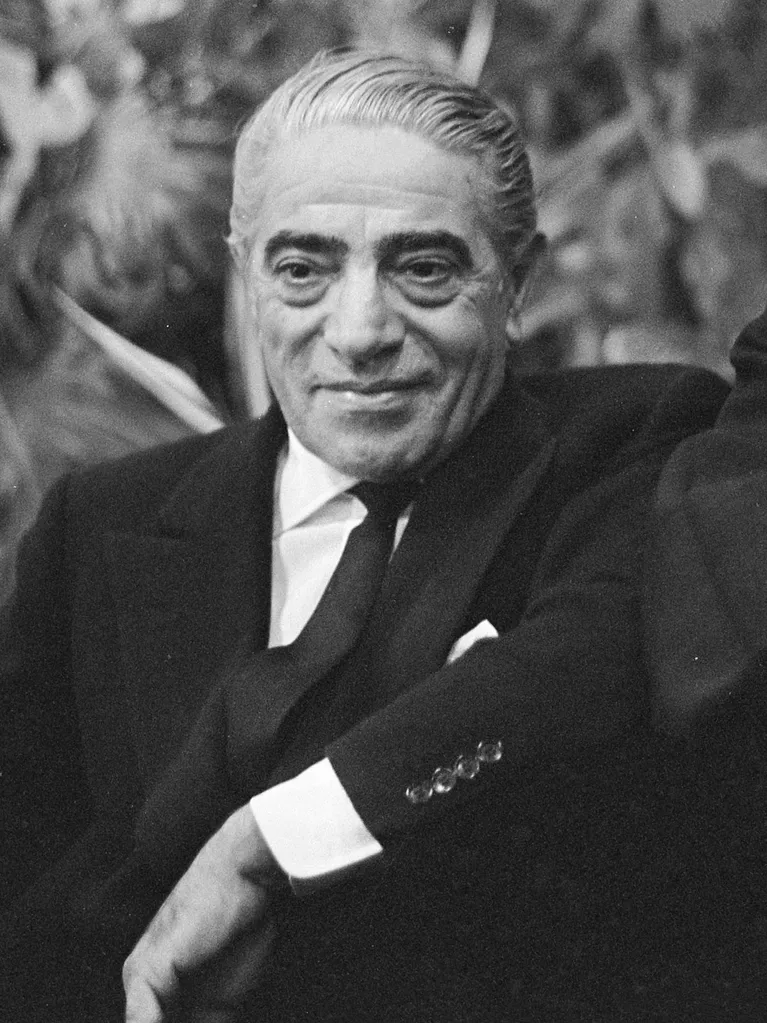
Archival photograph of Aristotle Onassis. Photo: Pieter Jongerhuis / Nationaal Archief. Wikimedia Commons, CC BY-SA 3.0 NL
Aristotle Socrates Onassis was a Greek shipowner, born in Smyrna, now Izmir, in January 1906, who built one of the largest privately owned tanker fleets of the 20th century. He also ran Olympic Airways, the Greek national airline, from 1957 until shortly before his death, and controlled for a time the company that owns the casino and hotels of Monte Carlo.
His business model can be summed up in three moves. He bought ships cheaply when others were selling, financed new ones against long contracts with oil companies and kept his costs and taxes low by registering ships and companies abroad. None of these moves was unique to him. What set him apart was the scale and the speed with which he repeated them.
From Smyrna to Buenos Aires
In September 1922, at 16, he fled Smyrna as the city burned. His family settled in Athens, and in August 1923 he sailed for Argentina on a Nansen passport, the travel document issued to stateless refugees after the First World War. According to the Encyclopedia of World Biography, he arrived with about $250 and worked as an electrician and then as a night-shift telephone operator in Buenos Aires.
The first fortune came from tobacco. In 1924 he set up an import-export company in Buenos Aires with help from his father and uncle, and by 1932, according to the Onassis Foundation, he had accumulated capital of about £50,000. He also gained a useful title: by 1931 the Greek government had made him deputy consul in the city. In the same year, according to Citi, he became a client of National City Bank, the predecessor of Citibank, a relationship that would matter more than any single deal.
How did Onassis buy his first ships?
When his father died in 1932, Onassis spent six months in the London office of the Drakoulis brothers, shipowners from Ithaca, and then moved into shipping himself. The world economy was in depression, freight markets had collapsed and owners were selling ships for little more than scrap value.
Sources disagree on the details of his first purchase, and the difference is worth showing. The Onassis Foundation says that in 1933 he bought two cargo ships of 5,500 gross tons each from the Canadian Steamship Company at £3,775 apiece and named them Onassis Penelope and Onassis Socrates. The Encyclopedia of World Biography says he bought six freighters from Canadian National Steamships at $20,000 each. Both agree on the seller’s country, the names of the first two ships and the logic: buy at the bottom of the market.
The step that defined his career came five years later. In 1938 he had the 15,000-ton tanker Ariston built in Gothenburg, Sweden, and chartered it to the Tidewater Oil Company. The Encyclopedia of World Biography describes it as the largest tanker of its day; the Foundation does not make that claim. Either way, it was the first ship he ordered new, and the first he paid for with a contract already in hand.
“The ship’s charter, not its market value, became the collateral.” Citi, on how it financed Onassis tankers
How did charter-backed loans build the fleet?
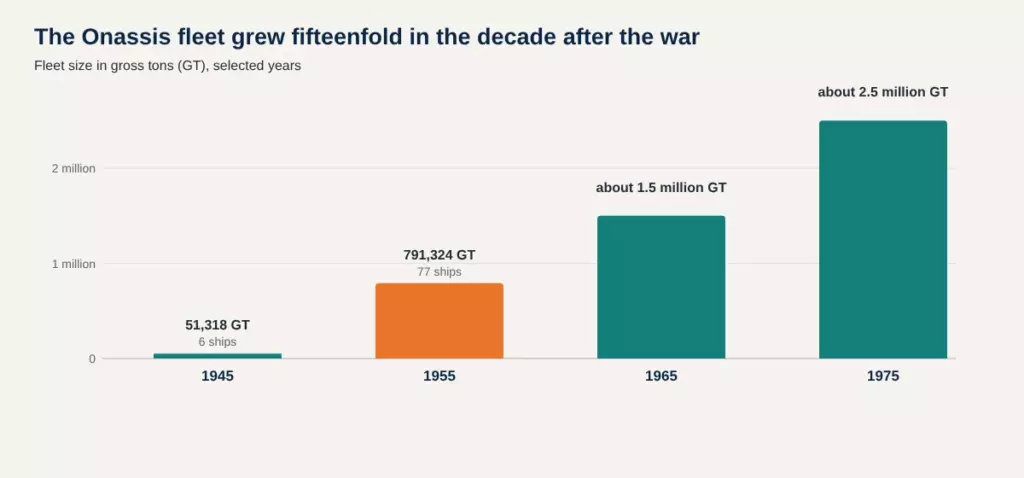
Diagram: Portolan, based on the Onassis Foundation biographical timeline, 2026
After the war, the U.S. Ship Sales Act of 1946 released many surplus government vessels, including Liberty ships and T-2 tankers, onto the market. Demand for fuel oil surged in 1947, and owners who had tankers could charge a premium, according to Citi’s account of its history with Onassis. He bought aggressively.
The financing method is the core of the story. A bank would normally lend against a ship’s resale value, which in a volatile market is a weak guarantee. Onassis brought the bank something better: a long-term charter with an oil company for a ship not yet built. The charter became the collateral, and the oil company’s charter payments went straight to the bank, which took its interest and principal before passing the remainder to the owner. In effect the loan rested on the oil major’s credit.
Citi’s example shows how fast the model could pay off. A standard T-2 tanker carried 16,600 deadweight tons. Onassis’s Olympic Games, a “supertanker” of 28,500 tons, was paid off within seven years against an expected 20. The more cargo a ship could carry for the same crew and fuel, the faster its charter repaid the loan, which pushed every new order toward a larger hull. The mechanics of the contracts themselves are covered in our guide to time charter, voyage charter and bareboat charter.
Over his career he bought 140 vessels of about 3.7 million gross register tons and raised more than $250 million from American banks to pay for them, according to the historian Gelina Harlaftis in Creating Global Shipping (Cambridge University Press, 2019). The fleet grew from six ships in 1945 to 77 ships of 791,324 gross tons in 1955.
| Year | Event | Fleet |
|---|---|---|
| 1933 | First ships bought, from a Canadian seller | 2 cargo ships (Foundation version) |
| 1938 | Tanker Ariston built in Gothenburg, chartered to Tidewater | first tanker |
| 1945 | End of the war | 6 ships, 51,318 GT |
| 1953 | Tina Onassis launched in Hamburg, then the world’s largest tanker | |
| 1954 | Tanker agreement with Saudi Arabia signed in January | |
| 1955 | Peak of postwar expansion | 77 ships, 791,324 GT |
| 1957 | Olympic Airways begins flying on April 6 | |
| 1965 | about 1.5 million GT | |
| 1975 | Death in Paris on March 15 | about 2.5 million GT |
Source: Onassis Foundation biographical timeline; International Maritime Museum Hamburg; data as of October 2026
How big did the Onassis fleet get?
The numbers show where the growth happened. Between 1945 and 1955 the fleet’s gross tonnage grew about 15 times, from 51,318 to 791,324 gross tons, by our calculation from the Foundation’s figures. Over the next twenty years it grew only about three more times, to roughly 2.5 million. The decade after the war, when surplus ships were cheap and oil demand was rising fast, built the empire; the decades that followed enlarged it.
Ship sizes tell the same story. The T-2 tankers of the war years carried 16,600 deadweight tons. The Olympic Games of the early postwar years carried 28,500, about 1.7 times as much. Tina Onassis, launched in 1953 with a capacity of about 45,000 tons, was the largest tanker in the world. A modern very large crude carrier is classed at 240,000 to 320,000 deadweight tons by the Baltic Exchange, roughly five to seven times the record of 1953. The race that Onassis and his rivals ran in the 1950s did not stop until the ships reached the limits of ports and canals.
It is also worth keeping the scale in proportion. Onassis was one of several Greek owners who grew rich on the same postwar opportunity, and his rival Stavros Niarchos was expanding in the same tanker market at the same time. The State Department memorandum of 1954 shows how directly the two competed, down to a Niarchos representative lobbying Washington against the Onassis financing.
Flags of convenience and the case against him
From 1939 Onassis registered companies in Panama, starting with Sociedad Maritima Miraflores, and later used Panamanian and Liberian flags for his ships. A flag of convenience offered lower taxes, cheaper crews and lighter regulation than the American or Greek registers, and it was legal. The trouble came from another direction.
U.S. law required ships under the U.S. flag to be owned by American citizens, and after the war Onassis had bought American surplus ships. In the early 1950s the government seized several of his ships and opened a Justice Department case, which Harlaftis dates to 1951–1958. In 1954 he pleaded guilty to violating the citizenship provisions of U.S. shipping law and paid $7 million. Harlaftis argues that the case made foreign businessmen convenient scapegoats for American political and economic concerns of the time; that is her interpretation, and the guilty plea is on the record.
Why did the Saudi tanker deal fail?
Illustration: Portolan
In January 1954 Onassis signed an agreement with the government of Saudi Arabia for an exclusive tanker arrangement: ships flying the Saudi flag would carry the kingdom’s oil. The deal brought him into conflict with the American oil majors, the U.S. government and much of the shipping world, according to Harlaftis.
U.S. State Department records published in Foreign Relations of the United States show how the opposition worked. In a memorandum of March 16, 1954, a representative of the rival Greek shipowner Stavros Niarchos asked the Department to encourage National City Bank and Metropolitan Life, which were believed to be financing the Onassis tankers, to cancel the loans. The Department recognized the dangers it saw in the agreement but was reluctant to act through the lenders. U.S. policy nevertheless aimed to make the deal ineffective, and it was never carried out.
The same year brought a second setback. Peru accused his whaling fleet of hunting within 200 miles of its coast without permission, and Peruvian naval vessels intercepted and captured most of it. For a businessman whose model rested on scale, 1954 showed the limits that governments could impose on a fleet that belonged to no single country.
Suez, supertankers and Olympic Airways
The closure of the Suez Canal in 1956 turned the setbacks into profit. Oil for Europe had to sail around Africa, the voyage grew longer, and tanker rates rose sharply. The Encyclopedia of World Biography reports that Onassis earned an extra $1 million a day during the crisis; the figure is widely repeated and difficult to verify. By the mid-1960s, according to Citi, he was launching a generation of very large crude carriers, and his fleet reached about 1.5 million gross tons in 1965.
The size race he helped start continued after him. Our guide to tanker sizes from Aframax to VLCC and ULCC explains what each class means today.
In 1956 he also bought the operating rights of the Greek state carrier, and Olympic Airways began flying on April 6, 1957. The airline gave him prestige more than profit: it lost money for several years, according to the Encyclopedia of World Biography. Late in 1974 he ended the airline’s contract with the Greek state, and it was renationalized on August 4, 1975, after his death.
The final years were hard. His son Alexander died in a plane crash at Athens in January 1973, aged 24 or 25 depending on the source. Onassis died at the American Hospital in Paris on March 15, 1975. His will created the Alexander S. Onassis Public Benefit Foundation, which received 45% of the estate, with the rest going to his daughter Christina.
The method he left behind
Strip away the yachts and the society pages and the Onassis method is a set of financial tools that shipping still uses: buy secondhand at the bottom of the cycle, order new ships against long charters, borrow against the cash flow of a contract and keep the ships under flags that minimize cost. Today’s large shipping groups do all of these through listed companies and bond markets.
He also showed the risk on the other side of the ledger. Every advantage of operating between jurisdictions became a liability when one government, or one rival, decided to use the law against him. In the 1950s that cost him $7 million in Washington, a whaling fleet off Peru and a Saudi contract that never sailed. Around the same years a former trucker in the United States was changing cargo shipping in a different way, a story we tell in our profile of Malcom McLean, the man who invented the shipping container.
The tankers kept getting bigger after both men were gone. Onassis’s lasting idea was that a ship is worth what its contract is worth.


