


A common belief about shipping’s energy transition is that the industry will settle on one clean fuel and switch to it, the way cars are moving to batteries. The order books tell a messier story. As of August 2026, 942 ships able to burn liquefied natural gas (LNG) were in operation and 705 more were on order; 159 ships able to run on methanol or ethanol were sailing, with 293 on order; and just five ammonia-capable ships were in service, with 41 on order, according to the Alternative Fuels Insight database of the classification society DNV.
Three fuels, three very different stages of maturity, and all of them still a small part of a fleet that mostly burns oil. This guide explains what each fuel is, what it costs, how much tank space it needs and which decisions in the next few months will shape the choice. Data as of October 2026.
Has shipping already chosen its fuel of the future?
The short answer is no. Shipowners are hedging. Most new ships ordered with an alternative fuel in 2026 can burn LNG, but most of them are dual-fuel and can also run on conventional oil. In the first half of 2026 owners ordered 137 alternative-fuel ships, and 73 of them were LNG-capable, mostly container ships and car carriers, according to DNV figures reported by gCaptain. Methanol orders nearly stopped, with two ships in six months, and ammonia accounted for four.
The table below compares the three fuels on the points that matter to an owner: how many ships use them, how much energy a ton contains and what makes each one hard.
| Fuel | Ships in operation | Ships on order | Energy per kg (lower calorific value) | How it is stored | Main drawback |
|---|---|---|---|---|---|
| Heavy fuel oil (reference) | most of the fleet | not tracked | 40.2 MJ | liquid, heated | carbon dioxide and sulfur |
| Marine diesel (reference) | most of the fleet | not tracked | 42.7 MJ | liquid | carbon dioxide |
| LNG | 942 | 705 | 48.0 MJ | cryogenic, about minus 162 °C | still fossil methane |
| Methanol and ethanol | 159 | 293 | 19.9 MJ (methanol) | liquid at room temperature | scarce green supply |
| Ammonia | 5 | 41 | 18.6 MJ | liquid at minus 33 °C or under pressure | toxic, new engines |
Source: DNV Alternative Fuels Insight via Engine, data as of August 2026; IMO resolution MEPC.245(66) for oil, LNG and methanol; IEA Advanced Motor Fuels for ammonia; PHMSA for LNG temperature
The engines behind these fuels are variations on the same giant two-stroke diesel that has powered cargo ships for decades, adapted to inject gas or alcohol. We explain that machine in how a container ship engine works.
LNG: the front-runner with a fossil problem
LNG has the advantage of an existing supply chain. SEA-LNG, an industry coalition that promotes the fuel, counts 222 ports worldwide where ships can bunker LNG, served by 67 bunker vessels with another 42 on order. Burning LNG cuts sulfur and particulate emissions sharply and reduces carbon dioxide at the funnel. Using the IMO’s own carbon factors, LNG emits about 57 kg of carbon dioxide per gigajoule of energy against about 77 kg for heavy fuel oil, roughly a quarter less by our calculation.
The catch is that LNG is still a fossil fuel. Its climate benefit depends on how much unburned methane escapes from the engine and the supply chain, a debate that is far from settled. Owners hedge by pointing to bio-LNG and synthetic methane, which can use the same tanks and engines. The same gas also moves by ship in large volumes: some of it comes from Arctic projects and sails along the Northern Sea Route.
Methanol: easy to handle, hard to source
Methanol is a liquid at room temperature, so it can be stored in ordinary tanks with modest changes and bunkered much like diesel. That made it the favorite of several large container lines a few years ago, and 159 methanol- or ethanol-capable ships were in service by August 2026.
The problem is supply. Most methanol today is made from natural gas or coal, which brings no climate gain. Green methanol made from biomass or from captured carbon and renewable hydrogen exists in small volumes and costs far more. Orders reflect that: owners signed contracts for only two methanol ships in the first half of 2026, according to DNV.
Ammonia: the first ships are at sea
Ammonia contains no carbon at all, so burning it emits no carbon dioxide. It is also toxic, corrosive and hard to ignite, which for years kept it on paper. That changed in June 2026, when EXMAR, a Belgian gas shipowner, took delivery of ANTWERPEN, a 46,000 m³ gas carrier built by HD Hyundai Heavy Industries with a WinGD X52DF-A two-stroke engine that can burn ammonia. It is the first of four sister ships.
Did you know? The first ocean-going ship with an ammonia dual-fuel main engine, ANTWERPEN, was delivered in June 2026, and it carries ammonia as cargo too. Source: WinGD via Cyprus Shipping News.
Gas carriers that transport ammonia make a logical first step: their crews already handle it as cargo, and the fuel is on board anyway. Broader use needs safety rules for crews and ports, a supply of ammonia made without fossil emissions and bunkering infrastructure that hardly exists yet. With 41 ships on order, ammonia remains the long-term bet.
How much energy is in each fuel?

Diagram: Portolan, based on IMO resolution MEPC.245(66) and IEA Advanced Motor Fuels, 2026
Energy content is where the alternative fuels pay their biggest penalty. A kilogram of methanol contains 19.9 megajoules and a kilogram of ammonia 18.6, against 42.7 for marine diesel. By weight, a ship needs a little more than twice as much methanol and about 2.3 times as much ammonia as diesel to sail the same distance.
Volume makes the gap larger. Using the densities published by IEA Advanced Motor Fuels, a cubic meter of methanol holds about 15.6 gigajoules and a cubic meter of liquid ammonia about 12.7, against about 32.9 for diesel. By our calculation a ship needs fuel tanks roughly 2.1 times larger for methanol and 2.6 times larger for ammonia, before counting insulation or pressure vessels. Every extra cubic meter of tank is space that cannot carry cargo, or a shorter range between bunkering stops.
LNG looks better per kilogram than oil, at 48 megajoules, but it must be kept at about minus 162 °C in insulated tanks, which take up space of their own. This is one reason the first adopters are large ships on fixed routes with predictable bunkering points.
What do alternative fuels cost?
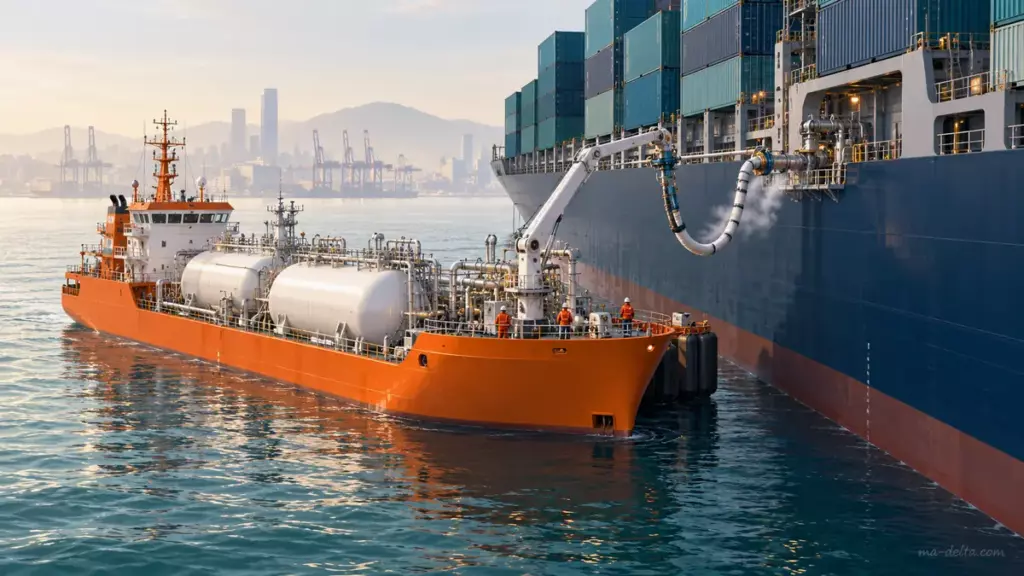
Illustration: Portolan
Price comparisons are only meaningful in energy terms, so the industry converts each fuel into its VLSFO equivalent, the amount of very low sulfur fuel oil that contains the same energy. On September 8, 2026, LNG cost $258 to $324 per ton of VLSFO equivalent more than VLSFO in Singapore and $261 to $395 more in Rotterdam, depending on engine type, according to the bunker price service Engine, which includes estimated compliance costs in its comparison. For reference, VLSFO itself traded at $946 per ton in Singapore on October 23.
Volumes remain small. Singapore, the world’s largest bunkering port, sold 56.77 million tons of marine fuel in 2025, of which 1.95 million tons were alternative fuels, according to the Maritime and Port Authority of Singapore. By our calculation that is about 3.4%.
Where the new ships are built is part of the economics too, a story we tell in our article on how China became the world’s shipyard.
What the IMO decides next
The fuel choice will depend heavily on regulation, and the key rule is not yet in force. The International Maritime Organization’s Net-Zero Framework, which would set a global fuel standard and a price on emissions from ships, was approved in draft in April 2025. Its formal adoption was adjourned for a year in October 2025, and in April 2026 the IMO’s environment committee, MEPC 84, kept the framework on the table and set up a working group to rebuild consensus, according to Carbon Brief.
The next window is close. An intersessional working group meets on November 23–27, 2026, MEPC 85 follows on November 30 to December 3, and if states agree the adjourned extraordinary session could resume on December 4 to adopt the framework, according to Engine. If adoption slips again, the next regular opportunity is MEPC 86 in October 2027. Data as of October 2026.
What to watch
For readers who follow the industry, five signals will show which way the fuel race is going:
- Whether the IMO adopts the Net-Zero Framework in December 2026, and with what fuel intensity targets for 2029–2035.
- The monthly DNV order counts: a revival of methanol orders or a jump in ammonia would mean owners see a clearer supply.
- The price gap between LNG and VLSFO, and the first published prices for green methanol and ammonia at major bunkering ports.
- Safety rules for ammonia as fuel, and the operating record of ANTWERPEN and its sister ships.
- How the alternative fuels fit with other changes on board, from wind-assisted propulsion to automation, which we cover in our articles on shipping technology and autonomous ships.

