


About 330 tonnes of fuel a day. That is what one of the most powerful diesel engines ever built would burn running flat out for 24 hours, by our calculation from its rated output of 80,080 kilowatts and its specific consumption of 171 grams per kilowatt-hour. The engine, a 14-cylinder Wartsila RT-flex96C, weighs more than 2,300 tonnes, stands 13.5 meters high and first went into service on the container ship Emma Maersk in 2006.
Almost every large container ship is driven by a machine of this kind: a two-stroke, low-speed diesel engine connected straight to the propeller shaft. This guide explains how it works, why ship designers keep choosing it, how big the largest examples are and how much fuel they need. Data as of November 2026.
Why do container ships use two-stroke diesel engines?
Because nothing else turns so much fuel into propeller thrust so cheaply. A low-speed two-stroke engine runs at about 80 to 100 revolutions per minute, slow enough to drive a large propeller directly, without a gearbox. It burns heavy, low-grade fuel that smaller engines cannot use, and it converts that fuel into work more efficiently than almost any other engine: at 171 grams per kilowatt-hour, the Wartsila engine turns about 49% of the energy in its fuel into shaft power, by our calculation using the standard reference heating value of 42.7 megajoules per kilogram.
A car engine, by comparison, spins at thousands of revolutions per minute and needs a gearbox. Ship designers trade that speed for size: each cylinder of a large marine engine is close to a meter across, and the engine makes its power through enormous force at low speed. How ship types and sizes are matched to their engines is covered in our guide to cargo ship classes.
How does a two-stroke marine diesel work?
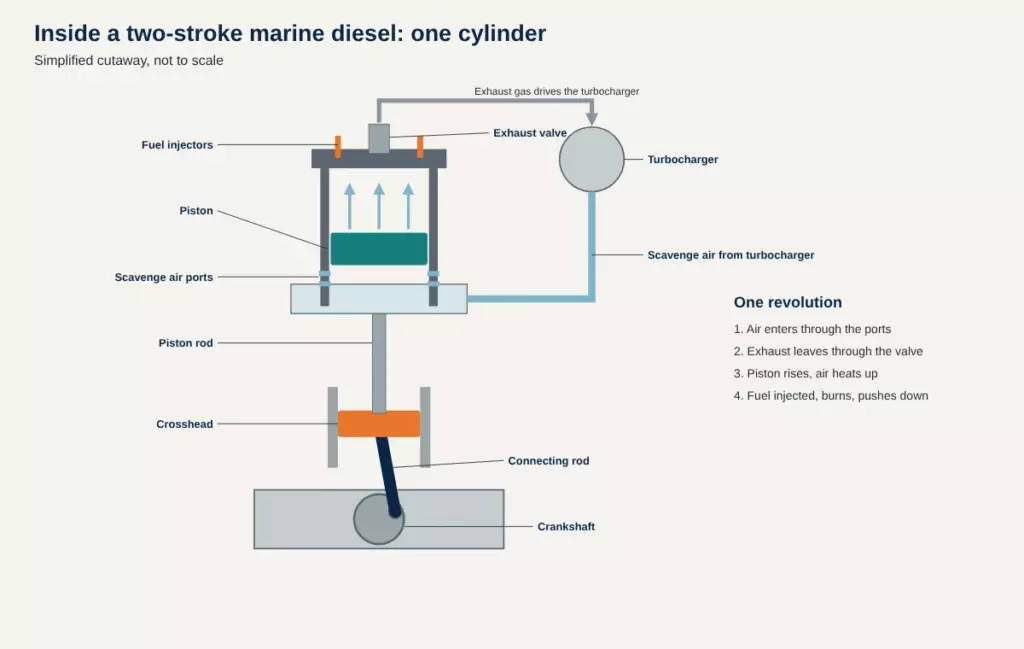
Diagram: Portolan, simplified, based on published descriptions of low-speed two-stroke engines by Wartsila, MAN Energy Solutions and WinGD
In one turn of the crankshaft, each cylinder completes the full cycle that a car engine needs two turns for. The sequence below follows one cylinder through a single revolution.
- Air in. Near the bottom of its stroke, the piston uncovers a ring of ports in the cylinder wall. Air compressed by the turbocharger rushes in through the ports and sweeps upward.
- Exhaust out. At the same time, a large valve in the cylinder cover is open, and the incoming air pushes the burnt gas out through it. Because the air enters at the bottom and leaves at the top, engineers call this uniflow scavenging.
- Compression. The valve closes and the piston rises, squeezing the air until it is hot enough to ignite fuel on contact. No spark plug is needed.
- Injection and power. Just before the top of the stroke, fuel is sprayed into the cylinder at very high pressure, burns, and drives the piston down. That downward push turns the crankshaft and the propeller.
The other cylinders fire in turn, so the shaft receives a steady series of pushes. To go astern, the engine is stopped and restarted in the opposite direction; there is no reverse gear.
What is a crosshead, and why do big engines need one?
A joint between the piston and the crankshaft that a car engine does not have. In a large marine diesel, the piston is fixed to a straight piston rod that moves only up and down. At the bottom of the rod sits the crosshead, a sliding block running in guides, and only below it does the connecting rod swing to and fro to turn the crankshaft.
The design keeps the sideways forces of the swinging rod away from the cylinder, so the piston and liner wear less. It also lets the cylinder and the crankcase be lubricated separately, with an oil suited to each. The price is height: the crosshead and its guides are one reason these engines rise several stories through the engine room.
Did you know? The crankshaft of the 14-cylinder Wartsila RT-flex96C weighs about 300 tonnes, and each of its pistons about 5.5 tonnes, according to figures compiled from Wartsila data.
How big are the largest marine engines?
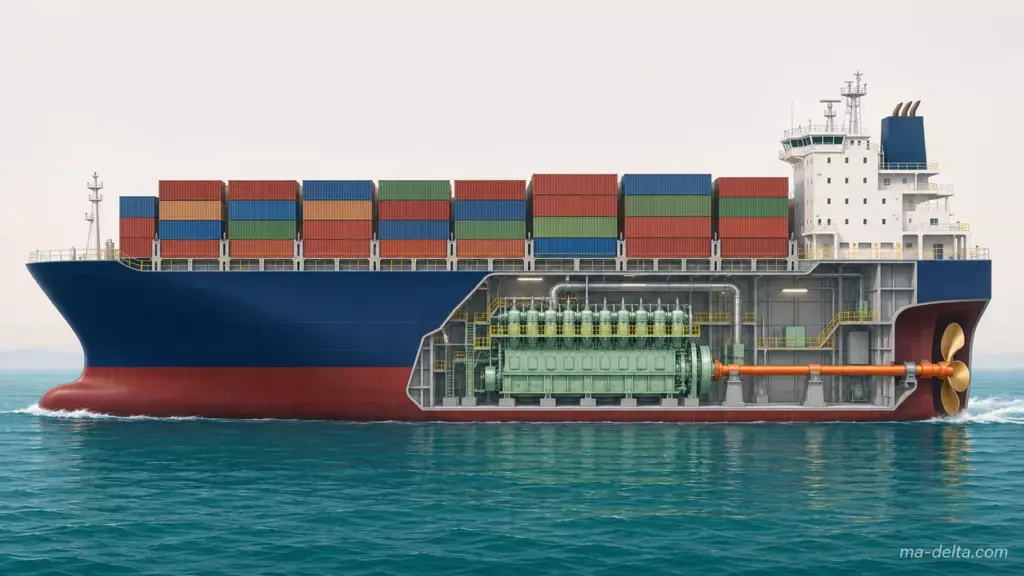
Illustration: Portolan
Table 1 compares three engines built for record-size container ships at different times.
Table 1. Three record-setting container ship engines
| Engine | First ship, year | Cylinders | Bore x stroke | Rated power | Speed | Size and mass |
|---|---|---|---|---|---|---|
| Wartsila RT-flex96C | Emma Maersk, 2006 | 14 | 960 x 2,500 mm | 80,080 kW | up to 102 rpm | 26.59 m long, 13.5 m high, over 2,300 t |
| MAN B&W 11G95ME-C9.5 | MSC Jade, 2016 | 11 | 950 x 3,460 mm | 75,570 kW | 80 rpm | not published in the report |
| WinGD 12X92DF (dual-fuel) | CMA CGM 23,000 TEU class, 2020 | 12 | 920 x 3,468 mm | 63,840 kW | 80 rpm | 22.87 m long, 15.92 m high, 2,140 t |
Source: Wartsila data via Wikipedia (RT-flex96C); SWZ Maritime, June 28, 2016 (11G95ME-C9.5); gCaptain, January 28, 2021 (12X92DF).
The table shows where design has moved. The newer engines are less powerful than the 2006 record holder, but their strokes are about a meter longer and they turn more slowly, at 80 revolutions per minute. A slower engine can drive a larger propeller, which pushes more water at lower speed and wastes less energy. The ships themselves have also changed: the largest container ships of the 2020s carry far more boxes than the Emma Maersk, as described in our guide to the largest container ships.
How much fuel does a container ship engine burn?
At full power, a great deal; in normal service, much less. The 330 tonnes a day in our opening figure assume the largest engine running at its full rating around the clock, which ships rarely do. Owners usually run their engines well below the maximum, and the saving grows quickly as speed falls. As a rule of thumb used by naval architects, the power a ship needs rises roughly with the cube of its speed. By that rule, a ship slowed to 80% of its design speed needs only about half the power, and uses about 36% less fuel for every mile it sails, by our calculation.
That arithmetic is behind the practice known as slow steaming: a longer voyage in exchange for a smaller fuel bill and lower emissions. It also explains why a new engine is often sold with a lower rating than its maximum, matched to the speed the owner actually plans to sail.
What fuels can these engines burn?
Traditionally, heavy fuel oil, a thick residue that must be heated before it will flow. Since 2020 most ships burn low-sulfur fuel oil or use exhaust scrubbers to meet international sulfur limits. A growing share of new engines are dual-fuel: the WinGD X92DF in Table 1 runs on liquefied natural gas as well as oil, and engine makers also offer versions for methanol and, in development, ammonia. Which fuel suits which ship, and what each costs in tank space, is compared in our guide to LNG, methanol and ammonia as marine fuels.
The engine in short
A container ship engine is a very large, very slow version of the diesel principle: air compressed until it is hot, fuel sprayed into it, and the resulting push turned straight into propeller rotation. Its size buys efficiency, its slow speed lets it drive a large propeller, and its tolerance of cheap fuel keeps freight costs down. The next decade will change what goes into its tanks far more than how it turns the shaft.

