

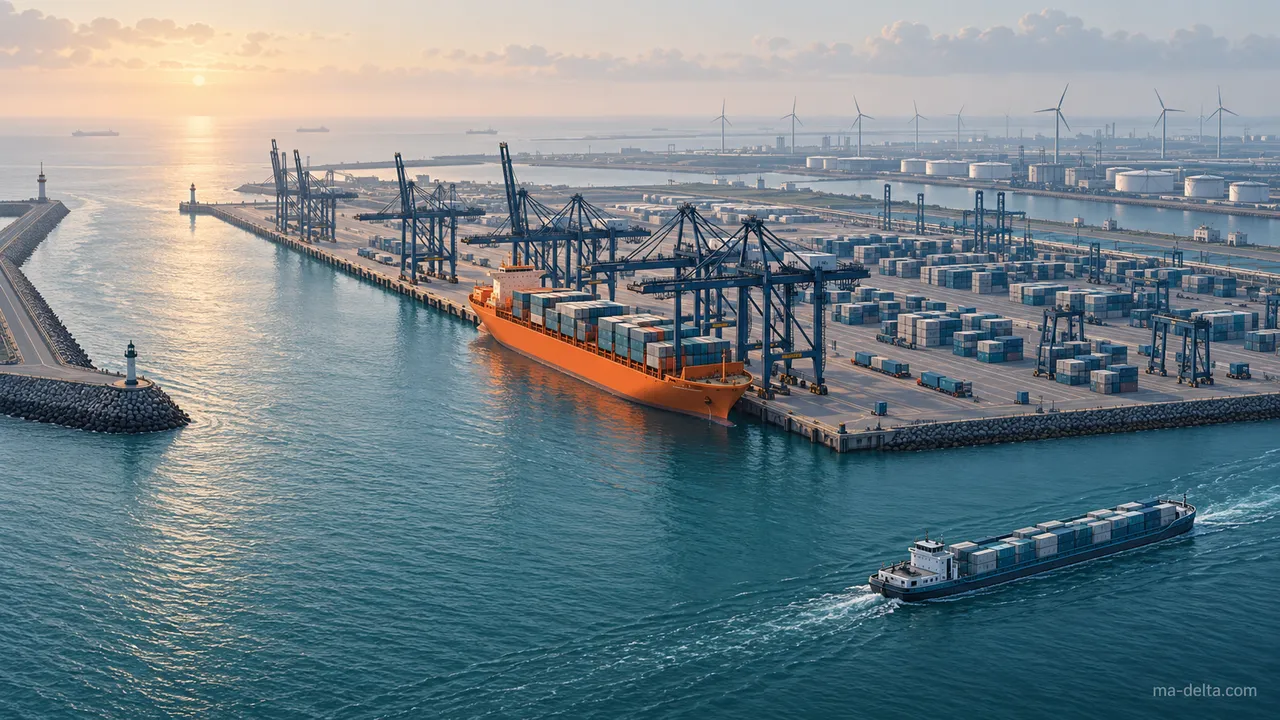
428.4 million tonnes. That is how much cargo passed through the Port of Rotterdam in 2025, according to the Port of Rotterdam Authority, more than Antwerp-Bruges and Hamburg combined. The port also handled 14.2 million containers measured in twenty-foot equivalent units (TEU), the most in Europe and 11th in the world by that measure, as our ranking of the largest container ports shows.
Size alone does not explain why shipping lines put Rotterdam first on their Asia-Europe rotations. The reasons are physical and mechanical: deep water close to the open sea, terminals built on reclaimed land, and a river and rail network that carries boxes deep into the continent. This article looks at how each of them works, using the Port Authority’s and the terminal operators’ own figures.
How big is the Port of Rotterdam?
Rotterdam is a port of oil and bulk as much as of containers. In 2025 crude oil was its largest single commodity at 101.2 million tonnes, while containers carried the most cargo of any segment, 133.2 million tonnes.
Table 1. Port of Rotterdam throughput by segment
| Segment | 2025 | Change on 2024 | First half of 2026, change |
|---|---|---|---|
| All cargo | 428.4 million t | -1.7% | +0.4% (212.0 million t) |
| Containers | 14.2 million TEU | +3.1% | -0.1% in TEU |
| Crude oil | 101.2 million t | +3.4% | +1.6% |
| Mineral oil products | not given in the summary | -12.6% | +11.5% (25 million t) |
| LNG | 13.0 million t | +15.1% | +1.7% (6.4 million t) |
| Dry bulk, all | not given in the summary | -6.5% | +1.7% |
| Roll-on/roll-off | 25.6 million t | +0.9% | +1% (13 million t) |
Source: Port of Rotterdam Authority, annual figures (via SWZ Maritime, March 2026) and half-year figures (July 24, 2026). Data as of October 2026
The 2025 decline came almost entirely from dry bulk: iron ore and scrap fell 11.5% and coal 8.7%. Containers grew, helped by a 9.3% rise in imports from Asia. In the first half of 2026 the picture shifted again. Deep-sea container volume rose 5.2% and trade with North America 13%, while transshipment, boxes that arrive on one ship and leave on another, fell 20%, according to the Port Authority.
How deep is the Port of Rotterdam?
Deep enough for almost any merchant ship afloat. The Port Information Guide published by the Port Authority in January 2026 sets the maximum draught, the depth of a ship’s hull below the waterline, at 22.55 meters (about 74 feet). That is enough for fully laden VLCCs, the largest crude tankers in regular trade, which few other ports in northern Europe can receive without first transferring part of the cargo to smaller ships.
The deepest ships reach the port through the Eurogeul, a dredged channel that runs 57 kilometers into the North Sea with a guaranteed depth of 25 meters. Vessels drawing 17.4 meters or more must use it; the port’s traffic controllers call them “geulers”, channel ships. Until December 2020 these were tankers and ore carriers. On December 11, 2020 the Marie Maersk left the APM Terminals terminal on Maasvlakte 2 at a draught of 17.4 meters, the first container ship ever to sail from Rotterdam as a channel ship, as reported at the time.
Geography helps. The container terminals and the oil and bulk berths of the Maasvlakte sit right at the coast, with no locks and a short run from the open sea. Hamburg, by contrast, lies more than 100 kilometers up the Elbe, and the largest ships there plan their arrival around the tide.
Did you know? Only about 1% of Rotterdam’s container volume was direct trade with Persian Gulf countries in the first half of 2026, so the disruption of shipping in the region had a limited effect on the port’s container business, according to the Port of Rotterdam Authority.
Which container terminals operate in Rotterdam?
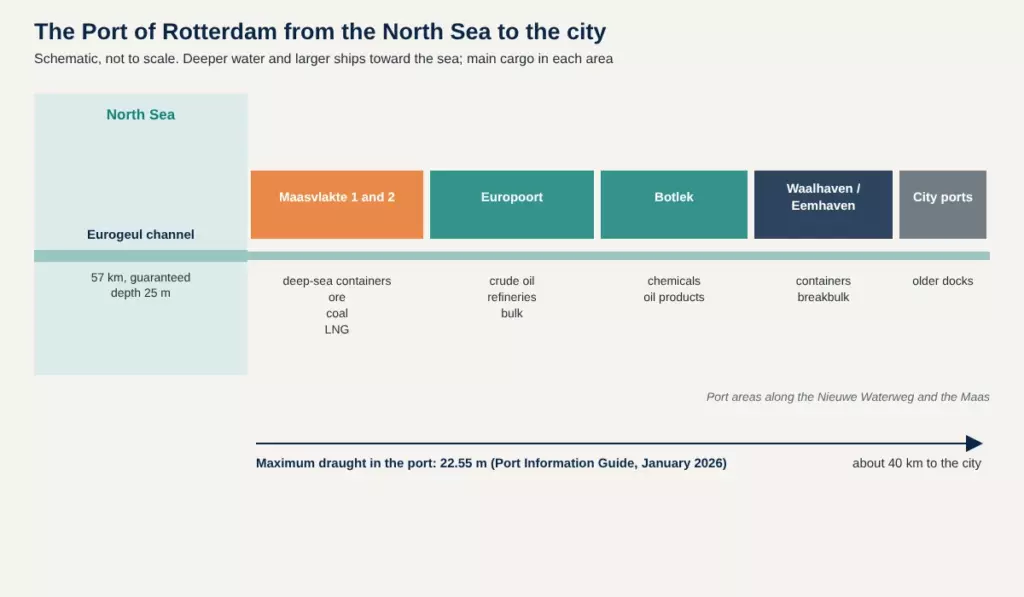
Diagram: Portolan, based on the Port of Rotterdam Authority, 2026
The large deep-sea container terminals sit on the Maasvlakte, land reclaimed from the North Sea in two stages: Maasvlakte 1 from the 1960s and Maasvlakte 2, which opened in 2013 and added roughly 2,000 hectares. Three operators run them on land leased from the Port Authority, and shipping lines are among their owners or anchor customers.
- Hutchison Ports ECT Rotterdam, part of Hong Kong’s CK Hutchison group, with the Delta and Euromax terminals. In 2019 it also agreed to buy the neighboring APM Terminals Rotterdam on Maasvlakte 1, FreightWaves reported.
- APM Terminals Maasvlakte II, owned by Maersk’s terminal arm. Its capacity was 2.7 million TEU a year in 2023, and an extension of about 2 million TEU on 47.5 hectares was scheduled to open in the second half of 2026, according to The Maritime Executive.
- Rotterdam World Gateway (RWG), owned by DP World, CMA CGM through Terminal Link, HMM and Ocean Network Express. Its capacity is about 2.6 million TEU a year; a third berth is due to start commercial operation in 2027, and a fourth before 2030 would take it to up to 5 million TEU, according to Container News in September 2026.
The newer terminals use automated stacking cranes and driverless vehicles that carry boxes between quay and yard. A dedicated internal link, the Container Exchange Route, connects terminals and depots on the Maasvlakte so that boxes can move between them away from public roads.
Older terminals upriver, in the Waalhaven and Eemhaven, handle short-sea and feeder ships that link Rotterdam with the UK, Ireland, Scandinavia and the Baltic.
How does cargo leave Rotterdam for the rest of Europe?
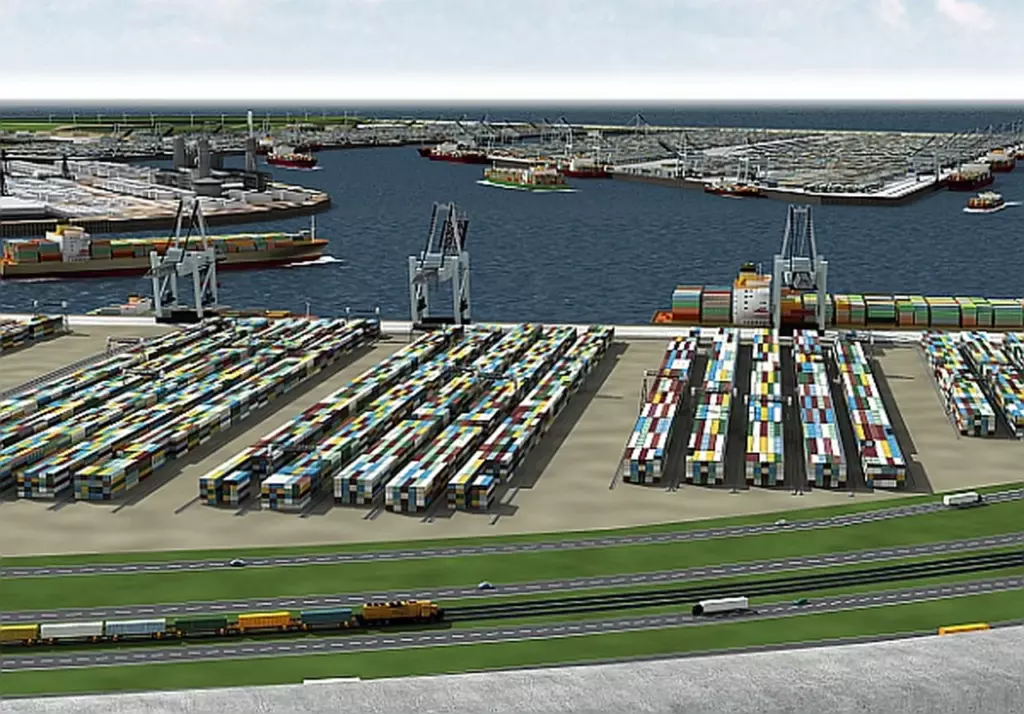
Future look of Maasvlakte 2 project of Mainport Rotterdam. Photo: Havenbedrijf Rotterdam N.V., Projectorganisatie Maasvlakte 2. Wikimedia Commons, Creative Commons Attribution-Share Alike 3.0 Netherlands license.
A port leads only if the goods can move on. Rotterdam sits at the mouth of the Rhine and the Maas, and inland waterways reach Germany’s industrial Ruhr area, Switzerland and France. In 2022, 30% of the containers moving between Rotterdam and the hinterland went by barge, 11% by rail and 59% by road, according to a report by Germany’s Federal Office for Logistics and Mobility cited by the European rail association UIRR.
That barge share is the port’s quiet advantage. A single large Rhine barge can carry the equivalent of many truckloads at lower cost per box, and for German customers a container can sail from a Maasvlakte terminal to an inland terminal near Duisburg without touching a road. Rail lines, including the dedicated Betuweroute freight railway to the German border, take boxes further to central and eastern Europe.
For importers, this means Rotterdam can be the cheaper port of entry for goods bound for Germany, even when Hamburg or Antwerp is geographically closer to the final customer. The routing decision belongs to the carrier and the forwarder, but it is worth asking which port and which inland mode a quote assumes.
Rotterdam, Antwerp-Bruges and Hamburg compared
Measured by weight of all cargo in 2025, Rotterdam handled 428.4 million tonnes, Antwerp-Bruges 266.5 million and Hamburg 114.6 million, according to figures published by the three ports and compiled by Trans.info. In containers the gap is narrow: 14.2 million TEU in Rotterdam, 13.6 million in Antwerp-Bruges and 8.3 million in Hamburg. Antwerp-Bruges even handled more container cargo by weight, 149.4 million tonnes against Rotterdam’s 133.2 million.
Each port has its niche. Antwerp-Bruges describes itself as Europe’s largest chemicals cluster and is a strong breakbulk port; Hamburg serves central Europe and the Baltic by rail and feeder ship. Across the Atlantic, the comparable gateway role is played by Los Angeles, Long Beach and New York-New Jersey, described in our guide to the largest ports in the United States.
Why Rotterdam leads
Deep water at the coast, land for terminals reclaimed from the sea, and a river that reaches the heart of German industry: Rotterdam’s lead rests on things competitors cannot easily copy. The 2025 dip in coal and ore shows how the port’s bulk business depends on Europe’s heavy industry, while the containers that keep growing depend on Asian trade and on the Suez route. The Port Authority’s own figures for the rest of 2026 will show which of the two weighs more.


