

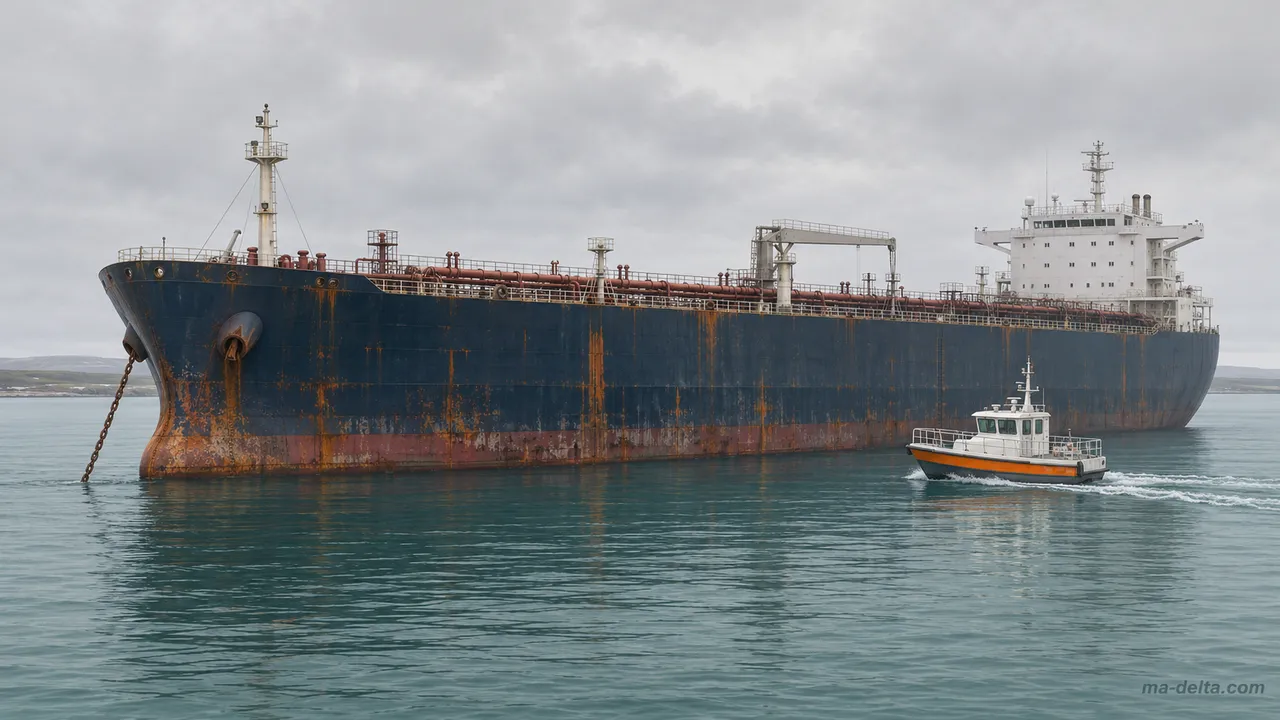
The phrase suggests a secret armada sailing without names or owners. The ships behind it are ordinary steel: tankers with IMO numbers, flags, registered owners and positions that anyone can follow on a commercial tracking screen, at least while their transponders are on. What sets them apart is the trade they serve and the services they do without.
The so-called shadow fleet is a label, used mainly by Western governments, the shipping industry and the media, for tankers that carry oil under sanctions from Russia, Iran or Venezuela outside the mainstream system of Western insurance, classification and finance. It has no definition in any international convention. Russia’s Foreign Ministry rejects the term: in June 2026 its spokeswoman Maria Zakharova said it has no basis in international law and called it a “political fabrication,” as Baird Maritime reported. This article sets out how big the fleet is by the main estimates, why the numbers differ and what risks it creates for shipowners, insurers, coastal states and cargo owners. Data as of November 2026.
Is there a legal definition of the so-called shadow fleet?
No. The closest thing to one is a resolution of the International Maritime Organization (IMO). Resolution A.1192(33), adopted by the IMO Assembly on December 6, 2023, puts “dark fleet” and “shadow fleet” in quotation marks and describes ships engaged in illegal operations: circumventing sanctions, evading safety or environmental rules, avoiding insurance costs and deliberately switching off ship identification signals such as AIS, according to a circular of the Maritime and Port Authority of Singapore. The resolution urges flag and port states to enforce existing conventions; it does not create a list of ships or a new legal category.
Sanctions lists work differently. The European Union, the United Kingdom and the United States each designate individual vessels by IMO number, and each list follows its own legal basis and criteria. A ship can be on one list and not on another. When a government says “shadow fleet,” it usually means the ships on its own list plus others it suspects; when an analytics firm says it, it means whatever its model counts.
That is why the term needs care. In our articles we write “the so-called shadow fleet,” name whose sanctions apply to a ship and report detentions and court decisions by what official documents say.
How big is the so-called shadow fleet?

Diagram: Portolan, based on S&P Global (2025 data), Lloyd’s List Intelligence (2025 data) and the EU 21st sanctions package (July 2026)
Somewhere between several hundred and more than a thousand tankers, depending on who counts and how. The main estimates differ less in quality than in definition.
Table 1. Estimates of the so-called shadow fleet and sanctioned tankers
| Source and date | What is counted | Number |
|---|---|---|
| S&P Global, September 2025 | tankers carrying oil from Russia, Iran or Venezuela with opaque ownership or services | 978 tankers, about 127 million dwt, about 18.5% of the oil tanker fleet |
| S&P Global, same estimate | of which linked mainly to Russia / Iran / Venezuela / more than one | 561 / 170 / 54 / 193 |
| Lloyd’s List Intelligence, December 2025 | tankers working with sanctioned Russian, Iranian or Venezuelan oil | 1,423 |
| Lloyd’s List Intelligence, same data | of which designated by the US, UK or EU | 921 |
| Council of the EU, July 23, 2026 | vessels on the EU list (port access and services ban) after the 21st package | more than 670 |
Source: S&P Global Commodities at Sea, via S&P Global Energy, September 3, 2025; Lloyd’s List Intelligence, via Baird Maritime, December 15, 2025; NorthStandard circular on the EU 21st package, July 2026. Figures use different definitions and are not additive.
On our reading, the spread is a matter of method. A sanctions list counts ships a government has named. An analytics firm counts ships whose behavior fits a pattern: ownership changes, a new flag, insurance outside the International Group of P&I clubs, cargoes from a sanctioned origin. Either way, the scale is large. S&P Global’s 978 tankers are close to one in five ships in the world oil tanker fleet.
Second-hand tankers and the price cap
Mostly second-hand ships that mainstream owners sold on. Demand for them grew after the G7 price cap on Russian crude took effect in December 2022 and Western insurers and shipowners could no longer carry cargoes sold above it. Many of these tankers are old: the average sanctioned ship was 21 years old in early 2025, about eight years older than the world average, according to S&P Global Market Intelligence data reported by India Seatrade News in January 2025.
Iran’s oil trade used a similar fleet long before 2022, and the two pools overlap: S&P Global counted 193 tankers in September 2025 that had carried oil from more than one sanctioned country. The size classes match the trade. Long-haul crude to Asia moves on VLCCs and Suezmaxes, while Aframaxes work the Baltic and the Black Sea; the differences between these ships are explained in our guide to tanker sizes.
The line between fleets is not fixed either. Since the conflict involving the United States, Israel and Iran began in February 2026, around 45 tankers and gas carriers from the so-called shadow fleet have moved into mainstream trades, Lloyd’s List Intelligence reported in October 2026. When freight rates are at record levels, as they have been in 2026, a ship that was sanctioned-trade-only can find legitimate cargo, and the reverse also happens. Hormuz traffic in that period is covered in our article on the closure of the Strait of Hormuz.
Did you know? The EU price cap on Russian crude stands at $44.10 a barrel, and the EU has paused its automatic six-monthly adjustment until July 15, 2027, according to NorthStandard’s summary of the 21st sanctions package of July 2026.
Why is insurance the biggest risk?

Illustration: Portolan
Because an oil spill or a wreck removal can cost far more than an old tanker is worth. Mainstream tankers carry protection and indemnity (P&I) cover from the International Group of P&I Clubs, whose 12 members insure about 87% of the world’s ocean-going tonnage and share large claims through a pool, as we explain in our guide to war risk insurance and P&I clubs. More than 800 of over 1,000 sanctioned vessels had no confirmed insurance in January 2025, according to the same S&P Global Market Intelligence data.
Without a known insurer, the coastal state may carry the bill. Under the international liability conventions, a tanker must hold certificates of insurance for oil pollution and wreck removal, but a certificate issued by an unknown company may be worth little when a claim is made. That is why coastal states have started to check documents at sea. The Danish Maritime Authority announced port state controls in February 2025 for high-risk tankers at the Skagen anchorage, with detention for ships lacking valid papers or insurance, Maritime Executive reported; the European Commission adopted a rule in April 2025 asking ships passing through EU waters to file insurance documents, according to the same publication.
The cargo is exposed as well. In January 2025 the Panama-flagged tanker Eventin was found drifting off the German coast with about 100,000 metric tons of oil, worth about €40 million, on board; German customs confiscated ship and cargo. On December 11, 2025, Germany’s Federal Fiscal Court ruled that the authorities could not for now sell or use them, upholding a lower-court decision in favor of the owners, Baird Maritime reported. Russian authorities said they had no information about the ship or its owner. The EU’s 21st sanctions package of July 2026 goes further and allows member states to confiscate and sell cargoes from detained vessels, according to NorthStandard.
Three costs for ordinary shippers
Three effects reach ordinary shippers. The first is freight. Ships that trade only in sanctioned oil are not available to anyone else, and analysts cited by Baird Maritime in December 2025 expected tanker rates to stay high into 2026 partly for that reason. When those ships return to mainstream trade, the effect reverses.
The second is compliance cost. Every charterer, trader, bank and insurer now screens counterparties and vessels against sanctions lists before a deal, and the lists change with each package: the EU added 41 vessels in July 2026 alone. Ports and terminals do the same. For importers, the practical checks are the subject of our guide to sanctions compliance in shipping.
The third is physical risk on busy routes. Old tankers with uncertain maintenance and insurance sail through the Danish straits, the Gulf of Finland, the English Channel and the Strait of Gibraltar alongside container ships and ferries. An accident involving one of them would be cleaned up and paid for by someone, and the question of who is exactly what the coastal states’ insurance checks are trying to answer.
Will the so-called shadow fleet shrink?
It depends on decisions that are still open. The EU has prepared, but not activated, a full ban on maritime services for ships carrying Russian crude and products; the legal basis was set up in the 20th package and “no decision on activating it has been taken yet,” NorthStandard wrote after the 21st package. Russia, for its part, rejects the legality of these measures: it says sanctions not approved by the UN Security Council are not international and that forcing ships into port on the high seas has no basis in the law of the sea, as the Russian Foreign Ministry stated in June 2026, according to TASS.
Meanwhile the ships keep aging. A tanker that was 15 when it joined this trade in 2023 is 18 now, while owners ordered 139 new VLCCs in the first half of 2026 alone, according to the shipbroker Allied, as cited in our tanker guide. Whether the old tankers are eventually scrapped, absorbed back into regulated trade or kept running until an accident forces the issue is the question that insurers and coastal states will be watching most closely.

